info@organametrisis.gr
210 2231624
210 2231624

The ultrasonic thickness gauge is an electronic device whose operating principle is based on the transmission and reception of sound waves to measure the thickness of a given material.
The basic operating principle of an ultrasonic thickness gauge lies in the use of an energy transducer (ultrasound transducer), which converts one form of energy (usually electrical) into mechanical energy (ultrasonic wave). This transducer is placed on the surface of the material under test, resulting in the propagation of acoustic energy inside the material, while the recording of the recovered signal can be done either using the same transducer or using another transducer. Regardless of the method of propagation and recovery of the ultrasonic waves, during signal acquisition the mechanical energy of the wave is converted into a suitable form of energy for analysis of the results..

An ultrasonic thickness gauge consists of two main parts: the main body of the device and the energy transducer. The energy transducer is connected to the body with an electrical cable, which sends and receives the required data to/from the body. The body itself contains sensitive and complex computing equipment, which is pre-programmed with everything needed for thickness measurement.
Its operating principle is based on the pulse-echo method (pulse echo method), which is the most widely used inspection technique and is based on the propagation and recording of ultrasonic waves using the same transducer, which functions as both transmitter and receiver simultaneously. The sound pulse produced by the probe propagates inside the material and, when it reaches the back surface of the sample, it is reflected. Thus, the echo emitted from the back surface reaches the receiver after time t; with this method the ultrasonic beam traverses the material twice (forward and back), which causes some attenuation.


Figure 1: Representation of the sensor coupling to the specimen and the propagation of sound within it. The diagram shows the intensity of the transmitted signal and the attenuated echo.
From the above, it is understood that the thickness calculation results from the formula:
$$T=V(t/2)$$
T: the thickness of the specimen
V: the speed of sound inside the specimen
t: the transmit-and-return time
An important note for calculating the thickness of a material is that sound propagates at a different speed in each material; this means that sound travels through different materials at different speeds..
Therefore, to accurately calculate the thickness of a specimen, the device must know the speed of sound in the material you are measuring. Because this is unique to each material, it is important to calibrate the device that will be used to measure the material thickness.
Below are some common materials and the corresponding relative speeds of sound in them..
| Material | Relative speed (m/s) | |
| Aluminum | 3040 – 6420 | |
| Brick | 3600 – 4200 | |
| Concrete | 3200 – 3700 | |
| Copper | 3560 – 3900 | |
| Glass | 3950 – 5000 | |
| Iron | 3850 – 5130 | |
| Lead | 1160 – 1320 | |
| Steel | 4880 – 5050 | |
| Wood | 3300 – 5000 |
After calibration, our device is ready to measure the sample accurately.
The second point that requires attention during measurement is to determine whether the surface of the material whose thickness will be measured is coated with any material. A coating is considered any material that covers the surface and prevents direct contact between the sensor and the material itself. Dirt, dust, rust, paint, varnish, etc. are some examples of specimen coatings that we may encounter.
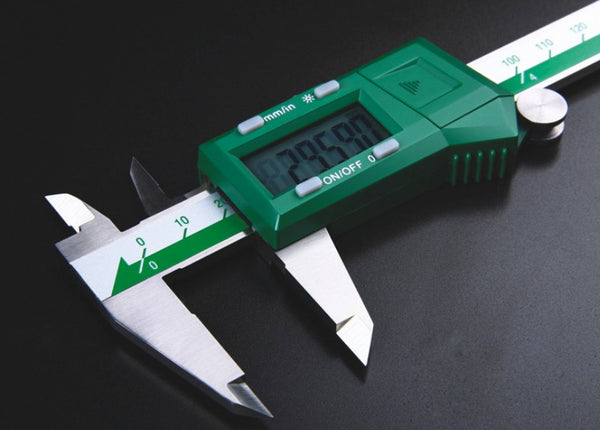
Measure the thickness of the material at one point (e.g., with a vernier caliper) and note the thickness. Now measure the thickness at the same point as the previous measurement with the gauge and change the sound velocity until the displayed value is the same as the one you noted. Record the sound velocity that has been set for the material. If you want to take further measurements of the current material, you must set the specified sound velocity before starting a measurement.
If you are using a device equipped with Single Echo, then coatings covering the surface will cause discrepancies in measurements and will give inaccurate results. In this scenario, it is important to ensure that the surface is clean and an insulating gel must be used to ensure clean contact between the sensor and the surface

Figure 2: The specimen and the movement of the acoustic signal within it are shown. At the top, the transmitted signal is shown, which defines the start of the timing; after time T1 the reflected signal is received.
For devices that use Echo-Echo and Multiple Echo methods, the coating is less of a problem for measurement. Echo-Echo allows our ultrasonic thickness gauge to ignore a coating thickness of up to 1mm. The advanced Multiple Echo method can ignore a coating thickness of up to 6 mm and, with the Deep Coat function enabled, the coating can be ignored up to 20 mm.
Echo-Echo and Multiple Echo use two and three timings respectively to eliminate the coating thickness and achieve an accurate result for the sample thickness

Figure 3: : The specimen and the movement of the acoustic signal within it are shown. At the top, the transmitted signal is shown, which defines the start of the timing; after time T1 the signal from reflection at the back side is received, and after time T2 the signal that starts from the boundary between the coating and the sample is received.
As shown in the image above, the second cycle of the acoustic wave starts from the boundary between the coating and the sample. This is the key factor for eliminating the coating from the measurement, because it means that timing T1 and timing T2 will be slightly different.
Multi Echo has a third timing for use, which increases measurement accuracy when the coating is thicker. For this, timings T2 and T3 are usually the same or minimally different, so that the meter’s computing hardware and software can eliminate the coating and record only the sample thickness.
The measurement process involves the device generating an ultrasonic pulse, which is sent through the material we want to measure. Timing starts when the pulse is initially emitted from the sensor and ends when the returning sound is detected, which results from reflection of the acoustic signal at the end of the specimen.
Contact probes are general-purpose for ultrasonic thickness gauges. These, like all ultrasonic probes, must come into direct contact with the material under test and emit sound waves perpendicular to the surface of the test material.
Delay line gauges are used for testing very thin materials, as they incorporate a small plastic waveguide or a delay line between the active element and the test piece that improves near-surface resolution.
Dual element probes are best for improving resolution when test surfaces are rough.

Figure 4: Parts of single- and dual-element energy transducers.
The received data can be presented on the device screen in various formats/types. Each presentation type offers a different perspective for examining and evaluating the material under test.
The A-scan (A-Scan) is the most common system. It displays the amount of reflected energy on a screen in waveform form. The horizontal axis of the screen represents the time the ultrasound travels within the material until it returns to the probe, while the vertical axis represents the signal amplitude, i.e., the acoustic energy returning to the probe.
The B-scan (B-Scan) provides an image of the specimen cross-section, which is achieved by scanning along its surface. On the screen, the horizontal axis represents the distance traveled by the probe during scanning, while the vertical axis represents the specimen thickness.