info@organametrisis.gr
210 2231624
210 2231624

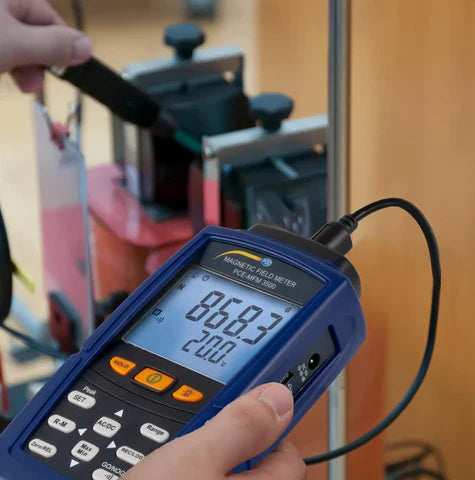
Vibration meters are suitable for regular recording of physical parameters such as vibration displacement (displacement), vibration velocity (velocity) and vibration acceleration (acceleration). Some vibration meters also have other measurement options, such as temperature measurement, speed measurement or determination of the bearing parameter. A vibration meter can be used to check the general condition as well as the condition of individual components (rolling bearings, gears, etc.) of a machine.
https://www.youtube.com/watch?v=s-wLOIqFnJE
Trend developments of these parameters provide information about impending damage. In this way, maintenance schedules or machine downtime can be planned depending on the condition of the machine. With this concept, a vibration meter increases operational safety on the one hand and at the same time increases machine efficiency due to optimized machine operating times and reduced downtime. As portable devices, vibration meters can be used autonomously, even in hard-to-reach places. Depending on the vibration meter model, measurement data can also be stored and then evaluated with the help of software.
When selecting a vibration meter, the following specifications are decisive: measuring range, frequency range, FFT analysis capability, determination of the bearing parameter, application of a vibration meter in a power generation unit, memory capacity, and other measurement functions. A common application is the monitoring and evaluation of machines according to DIN EN ISO 10816. This standard classifies various machine sizes according to transmitted power and assigns limit values to the individual categories, compliance with which ensures safe, trouble-free operation.
Another important parameter in vibration monitoring is speed. Some vibration meters therefore have built-in contact or non-contact speed sensors with which speed can be determined directly on site. Since defective components or bearings often generate increased friction values during rotation, the surface temperature of a machine in the immediate vicinity of critical components can also provide valuable information about the condition of the machine. Some measurement data collectors therefore also have temperature sensors for determining surface temperature.
Another useful function is FFT analysis. With this frequency evaluation, the vibration behavior of a machine can be analyzed with regard to vibration frequencies. Vibration meters with the corresponding function show the machine’s frequency spectrum on the display. Frequency peaks within the spectrum may indicate damage to rolling bearings. In order to locate faults more precisely, the component fault frequencies at a given speed are required. Fault frequencies can be calculated using formulas, and information about this can often be obtained from the component manufacturer.
Vibration measurements can and should be taken not only to monitor the condition of the machine, but also to determine the effect of machine vibrations on the machine operator. Vibrations may be permanent and continuous or may occur only periodically. Vibrations may be inertial (i.e., a force acting on an object), relative, or free (when there is displacement). Depending on the operator’s position and proximity to the equipment, they may experience whole-body or hand-arm vibration.

If exposure exceeds permissible limits, the operator may experience long-term problems with their fingers, hands, back, and other parts of their body. Therefore, regardless of the type of vibration involved, vibration should be evaluated according to its impact on the health and safety of the machine operator. If possible, changes to the machine itself (or to the time the operator spends using the machine) should be made immediately to prevent or limit the operator’s exposure to harmful vibration.
Vibration meters are also used to measure vibrations in buildings. There are many factors that can contribute to vibration in buildings, such as the building’s proximity to high-traffic roads, railway lines, airports, quarries, construction sites, and other heavy industrial areas. In addition, buildings can vibrate due to natural causes such as wind, weather, and earthquakes, or due to the operation of internal building elements such as elevators and heating, ventilation, and air conditioning (HVAC) systems. Vibration testing helps identify areas of a building that are at higher risk of vibration. Regular vibration monitoring in high-risk areas can provide property managers with advance notice of vibration-related structural issues.
Permissible exposure limits for vibration are set by entities such as the International Organization for Standardization (ISO). ISO vibration regulations include: