









































































































































Sound Level Meters

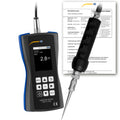
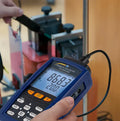
A sound level meter is an instrument for measuring sound level. It is used to measure the sound intensity in a space and typically expresses the measurement in decibels (dB).
Where is it used?
- In factories and workplaces for noise control.
- In environmental measurements (e.g. measuring noise pollution on roads, squares, etc.).
- In concert venues to monitor sound level.
- In offices and schools to comply with quietness regulations.
- In laboratories for research and precision measurements.
How does it work?
The sound level meter has:
- A microphone that captures the sound.
- An analysis circuit that processes the signal.
- A display that shows the sound level in dB.
Types of sound level meters
- Basic sound level meters for simple measurements.
- Precision sound level meters (Class 1) for professional use.
- Portable sound level meters for quick on-site measurements.
- Logging sound level meters that store measurements for later analysis.
What does it measure?
- Sound pressure level (SPL).
- Time-averaged noise level (Leq).
- Maximum and minimum level (Lmax, Lmin).
What is the difference between class 1 and class 2?
The manufacturing standards for sound level meters are IEC61672-1:2002 or BS EN61672-1:2003, which define a wide range of criteria that the instrument must meet. Therefore, in the applicable standard IEC61672-1:2002 there are two tolerance levels, known as classes 1 and 2.
Below we provide the tolerance response graph for class 1 and class 2 sound level meters, as well as a table with indicative tolerances at specific frequencies.

Figure 1: Tolerance curves (dB) over the operating frequency range of sound level meters
| FREQUENCY (Hz) | TOLERANCES (dB) |
|---|---|
| Class 1 | Class 2 |
| At the reference and calibration frequency 1kHz. | ±1,1 |
| At the lower extreme frequency 20 Hz | ±2,5 |
| At the lower extreme frequency 20 Hz | +2,5-4,5 |
| At high frequency 10 kHz. | +2,6-3,6 |
| At high frequency 16kHz. | +3,5-17 |
Table 1: Discrete frequency values and tolerances in (dB) for class 1 and class 2 sound level meters.
What are the characteristics of A and C weighting filters?
The human ear is more sensitive to sound in the 1 to 4 kHz frequency range than at very low or very high frequencies. With regard to noise, higher sound pressures at lower and higher frequencies than in the mid-range are more acceptable as noise.
Knowledge about the human ear is important for acoustic design and sound measurement. To compensate for human hearing, sound level meters are usually equipped with filters that adjust the measured sound response to the human perception of sound.
The most common filters are:
- A-weighting or dB(A)
- C weighting or dB(C)

A-weighting or dB(A)
A-Weighting: A-weighting is a standard weighting of audio frequencies designed to simulate the response of the human ear to noise. Measurements made with this weighting will be displayed as dB(A) or dBA.
dB(A) is the widely used filter. dB(A) approximately corresponds to the inverse of the 40 dB equal-loudness curve (at 1 kHz) for the human ear.
C weighting or dB(C)
C-Weighting: C-weighting places much more emphasis on low-frequency sounds than A-weighting and is essentially flat or linear between 31,5Hz and 8kHz. Measurements made with this weighting will be displayed as dB(C) or dBC.
The C decibel filter is practically linear over several octaves and is suitable for subjective measurements at very high sound pressure levels.
Below we provide a graph of the response of the A and C filters, which are the most common, as well as B and D, which are also found in some sound level meters.

Figure 2: Response of filters A, B, C and D over the operating frequency range of sound level meters.
What is the difference between a sound level meter, a spectrum analyzer, and a noise dosimeter?
The sound level meter is the meter that measures the sound level, while the sound spectrum analyzer also performs analysis of the sound across the frequency range. The spectrum analyzer has an additional stage in its electronics, a band-pass filter that can perform spectrum analysis in 1 Octave (8Hz=16kHz with 10 steps) as well as in 1/3 Octave (6,3Ηz-20kHz with 33 steps). The noise dosimeter measures noise exposure over a duration of 8 hours (dose).
What is fast, slow, impulse evaluation of noise level?
The fast, slow, impulse selection is an option for the instrument’s exposure and sampling time during the measurement. Each of these has a specific sound level evaluation duration:
Fast: fast average-value evaluation, duration 125ms, application for steady noise variations (traffic noise, neighborhood noise, industrial noise)
Slow: slow average-value evaluation, duration 1s, application for steady noise (monotonous hum).
Impulse: impulse evaluation, duration 35ms, application for explosive noise (guns, hammer blows).