info@organametrisis.gr
210 2231624
210 2231624

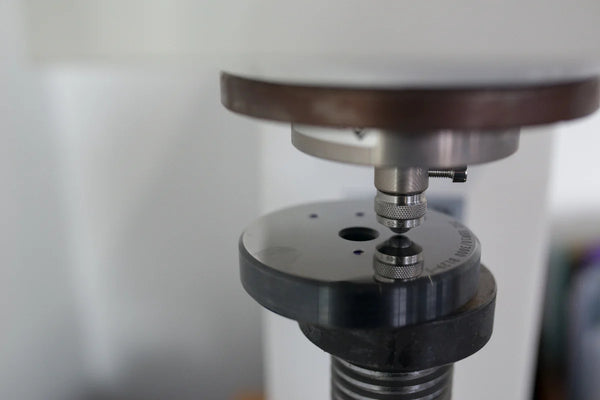
The Rockwell method is a static hardness testing method, which has the following characteristics:·
TABLE 2
| Scale | Abbreviation | Load(1kgf=9,81N) | Indenter | Use |
|---|---|---|---|---|
| A | HRA | 60 kgf | 120° spherical-conical diamond | Tungsten carbides |
| B | HRB | 100 kgf | 1⁄16-inch-radius(1.588 mm) steel ball | Aluminum, brass and mild steels |
| C | HRC | 150 kgf | 120° spherical-conical diamond | Hard steels >HR B100 |
| D | HRD | 100 kgf | 120° spherical-conical diamond |
Operating principle
In the Rockwell method, the total test force is applied in two phases. In the first phase, a preload force is applied so that the indenter reaches a depth h0 into the material; in the second phase, the additional force is applied, resulting in the indenter reaching a depth h1. The initial preload force plus the additional test force gives the total test force (also referred to as total force or major load). The total force is applied to the specimen for a specific period of time, after which the additional force is removed, causing the indenter to move upward to a higher level at depth h2 (Figure 2).
The Rockwell hardness (HR) can now be calculated using the residual depth h= h2.- h1 of the indentation.

Figure 2: Operating principle of Rockwell hardness measurement.
:::info
Abbreviation explanation
1. Numerical hardness value
2. The two letters "HR" indicate the Hardness Rockwell method.
3. The designation of the Rockwell scale is defined by the combination of the major load (total test force) and the type of indenter used.