info@organametrisis.gr
210 2231624
210 2231624
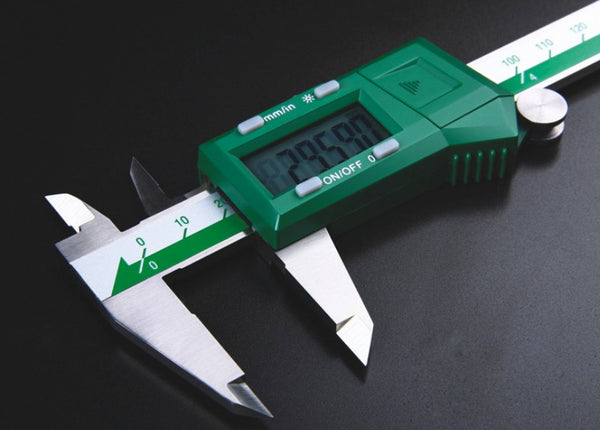
The caliper is undoubtedly the most basic measuring instrument. Ease of use, wide range, low cost, and the large number of applications make it the primary general-purpose measuring instrument. A standard caliper has 2 pairs of jaws, one for external measurements and one for internal measurements. In addition, it also has a depth measuring rod for depth-gauge-type measurements, which is available in flat as well as round types.
Calipers are of 3 types:

Diagram of a vernier caliper showing a measurement of 2.475cm ± 0,005 cm on the metric scale. The parts of the caliper are:


For more information regarding waterproofing of digital instruments
For measuring large parts, steel rules are usually used for rough measurements. However, if higher accuracy is required, heavy-duty calipers become necessary. Long-length calipers are very convenient for the user, but they require some care during use. First of all, it is important to realize that there is no relationship between readability and accuracy.
Readability is fixed, while accuracy can vary dramatically depending on how the caliper is used. Measurement technique is important, as even a small deflection of the instrument beam will cause a large error. Therefore, measurement accuracy depends to a large extent on the method used to support the caliper.
Additional care is required so that you do not apply excessive force to the jaws. Since the large jaws are farther from the main beam than on normal small calipers, the error here will be at its maximum.

Errors during measurement with a caliper can arise for various reasons. The most important reasons are the parallax effect, the fact that the caliper as an instrument does not comply with the Abbe principle, and differential thermal expansion due to the temperature difference between the instrument and the workpiece being measured.
Although there are other error factors, such as the accuracy of the graduation, the flatness of the fixed beam, and the squareness of the jaws, these factors are included in the error limits by the manufacturer.

Place the jaws as deep as possible before measuring.
Read the maximum value during internal measurements.
Read the minimum value during external measurements.
Read the minimum value during depth measurements.
Always look at the vernier in a straight line. If we look at the vernier graduation from an oblique direction (A), the apparent measurement position is shifted by ΔX as shown in the figure below. This shift is due to the parallax phenomenon caused by the height difference (H) between the planes of the two graduations. To avoid this error, JIS specifies that the height difference must not be more than 0,3mm.

If the moving jaw goes out of parallel with the fixed jaw, either due to excessive force or due to lack of straightness of the beam, an error will occur as shown in the figure.

The main scale of a caliper is engraved on stainless steel, and although its coefficient of thermal expansion is equal to that of the most common material to be measured, i.e. steel (10.2 ± 1) × 10-6 / Κ, it should be noted that room temperature and the temperature of the workpiece being measured can affect measurement accuracy.
Handle the instrument carefully and avoid any impacts or drops on the floor.