





































































































































Infrared Thermometers

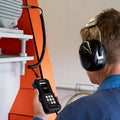
The infrared thermometer is the ideal instrument for non-contact temperature measurement of moving objects, objects carrying current, or objects at high temperatures. An infrared thermometer is sometimes called a laser thermometer due to the integration of a laser for aiming purposes. Infrared thermometers use thermal radiation, also known as black-body radiation, emitted by an object to determine its surface temperature.
Emmissivity (thermal emissivity coefficient) is a key factor when selecting an infrared thermometer, as different material surfaces have different emission values. Therefore, it is important to take into account the thermal emissivity coefficient of the material to be measured when purchasing an infrared thermometer. Alternatively, if you want to measure many different objects using the same infrared thermometer, it is important to look for an infrared thermometer that allows the user to adjust the emission value according to the material surface to be measured—e.g. paper, wood, metal, etc.
If the infrared thermometer is used to measure shiny metallic surfaces, such as stainless steel, the device can only be used to determine temperature trends, as it is not possible to measure the absolute temperature of polished or buffed surfaces with an infrared thermometer.
Tips for buying an infrared thermometer
An infrared thermometer is used to measure the surface temperature of an object without touching the object's surface. In practice, the object whose surface temperature is to be measured can be anything from a car tire to a furnace heating element. This flexibility makes the infrared thermometer an extremely useful tool for inspection professionals in many different industries. However, to ensure accurate measurement results, the specifications of an infrared thermometer must align with the requirements of the application. How do you determine which infrared thermometer best fits your application? The text below is designed to help you make an informed purchasing decision.
Key questions to ask yourself when selecting an infrared temperature measurement system:
What type of device does your application require (e.g. handheld or fixed infrared thermometer)?
What emissivity value is recommended for measuring the surface temperature of your material?
What distance-to-target or distance-to-spot (D / S) ratio does your application require? - What degree of infrared thermometer accuracy is necessary to successfully complete your task?
What memory size and data transfer interface is required, if any?
What level of after-sales service and support is desired?
What is your budget for an infrared thermometer?
Below is a more detailed analysis of the criteria to keep in mind when selecting an infrared (IR) thermometer:
Handheld or Fixed?
The answer to this question largely depends on the intended application. If you want to use the IR thermometer to collect measurements sporadically for quality assurance, you should use a handheld infrared thermometer. If you want to measure continuously and use the readings for process control, it would be better to use a fixed infrared thermometer. A fixed IR thermometer must be equipped with an interface for transferring measurements to a control system. The transfer can be analog or digital.

Thermal radiation emissivity coefficient (emmissivity)
An infrared thermometer can also have its disadvantages. One such disadvantage is the need to know the required emissivity. The emissivity of a material is the relative ability of its surface to emit or absorb energy from radiation. The thermal radiation emissivity coefficient depends not only on the type of material, but also on the intended surface temperature and the wavelength (μm) of the infrared thermometer. Another disadvantage is that the emissivity of metals varies widely, making accurate measurement difficult. For example, at 25 ° C (77 ° F) heavily oxidized copper has an emissivity of 0.78, but at 527 ° C (980.6 ° F), the same oxidized copper has an emissivity of 0.91, while polished copper has an emissivity of 0.012 at 327 ° C (620.6 ° F).
While most glasses, ceramics, plastics, woods, and organic materials have very high emissivity coefficients (about 0.95) in the mid-infrared range (MIR) and in the far-infrared spectrum (FIR), pure metals have much lower emissivity within the MIR scale and in the near-infrared radiation (NIR)—e.g., polished gold within the MIR has an emissivity of about 0.02. However, when the metal is anodized (such as aluminum) or heavily oxidized, it will have a higher emissivity of about 0.9 within the MIR.
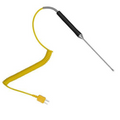
Many infrared thermometers have the ability to adjust the emissivity coefficient. Often the emissivity is adjusted with a rotary knob with a range of 0 ... 1. Some instruments also have an additional measurement input for a contact temperature sensor (or thermocouple).

If you want your thermometer to be calibrated for the emissivity coefficient of an unknown material, the temperature can be measured with this additional sensor. The emissivity setting for the radiation will be adjusted until the non-contact measurement produces the same measurement result as the measurement with the contact sensor.
Distance-to-Target Ratio (Distance to spot ratio)
Every infrared thermometer has a lens with a specific distance-to-target ratio or distance-to-spot, also known as the cone (D / S). Specifications such as 2: 1, 10: 1, or 20: 1 are very common for low-cost IR thermometer devices. When considering high-quality infrared thermometer devices, specifications can reach up to 75: 1.
 These values can also be expressed as x: y. This means that the measurement spot has a diameter of y when the distance to a surface is x. For example, if an IR thermometer has a distance-to-target ratio of 20: 1, you can stand 20 centimeters away from your target and measure the temperature of a one-centimeter circle. This is similar to the cone of light emitted by a flashlight. If you move very close to a wall with a flashlight, the cone of light will be smaller than when you are farther away from the wall. More advanced infrared thermometers can reduce or increase the size of this measurement spot to meet the size requirements of the application.
Accuracy
Each infrared - laser thermometer has its own accuracy specifications that depend on the temperature range being measured. Typically, a higher-accuracy measuring instrument will be more expensive, so it is important to consider practicality as well as accuracy. In addition to emissivity, factors that will affect each measurement include geometry (flat, concave, convex), finish (polished, rough, oxidized, sandblasted), and measurement angle. Therefore, when taking comparative temperature measurements with an infrared thermometer, it is necessary to establish a check to minimize the effects of the various variables in order to record the most accurate readings.
Memory and data transfer
Some thermometers have the ability to store measurements in internal memory or an SD memory card. The memory size may be presented as a number of GB or as the maximum number of stored readings.

This memory typically allows temperature measurement data to be downloaded to a computer using a USB port, RS-232, or an SD card reader. In most cases, an IR thermometer with temperature data logging capability is equipped with a USB connection. In some cases, special computer software is required to transfer the measurement data.

More information
An infrared thermometer is also often referred to as a laser thermometer, non-contact thermometer, IR, or pyrometer. Infrared thermometers use infrared radiation, also known as thermal radiation, to indirectly measure surface temperature without contact. William Chandler Roberts-Austen is credited with the invention of the radiation thermometer. Any object with a temperature above 0 degrees Kelvin (K) emits radiation. An infrared thermometer measures only the temperature of a visible surface. Therefore, an infrared thermometer cannot take measurements through glass. If the measured object is cooler than the IR thermometer, the radiation flow is negative. To calculate the temperature, the infrared thermometer sends thermal radiation to the measured object to correct the negative flow.
Advantages
Measurement results can be obtained very quickly, from 10 μ to 1 second depending on the device. The IR thermometer also eliminates errors due to poor thermal contact. There is little wear on the infrared thermometer, even in handheld portable units. High voltage, electromagnetic fields, and corrosive materials do not affect the measurement process. Measurements taken with an infrared thermometer do not damage sensitive objects such as plastic films or paper products. Another important advantage is that, because measurements can be taken without contact, an infrared thermometer is a much safer tool to use in high-temperature situations.
Infrared - laser thermometers - Practical applications
As mentioned, the main advantage an infrared thermometer has compared to a standard contact thermometer is that it provides the ability to measure from a distance using the emission of thermal radiation. This means that within a few seconds it is possible to determine the temperature in parts of machines, engines, or systems that cannot be easily accessed without shutting them down.

In fact, because an infrared thermometer measures the emission coming from the surface of the material or object (since all objects emit energy and electromagnetic waves depending on their temperature) and since the energy depends on the temperature of the object being measured, the surface temperature of the object can be measured without close proximity and direct contact. Due to the installed software and laser sight, the infrared thermometer determines the emissivity coefficient of the object to be measured and provides an accurate reading of the surface temperature.

Thus, an infrared / IR thermometer is an ideal solution for monitoring heating, ventilation, and air conditioning (HVAC) systems. An infrared thermometer can be used for regular monitoring of HVAC systems as well as for troubleshooting and identifying the cause of an unrecognized malfunction. The condition of an HVAC system plays an important role in any business, factory, warehouse, school, or home. An infrared thermometer can be used to examine ducts, pipes, and walls. HVAC system maintenance is a difficult task, as not all components of the HVAC system are open for direct access and inspection. This is why, in HVAC testing, adjusting and balancing (TAB), the use of direct-contact measuring devices is not always suitable or easy. Difficulties often arise not only from obstacles created by limited access to key measurement points within the HVAC system, but also from potential risks to the HVAC technician, for example when the temperature of an HVAC system component becomes too high for contact measurement. An infrared thermometer allows HVAC professionals to perform the necessary HVAC system tests and inspections on site, without using ladders or too much other auxiliary equipment, checking the condition of air ducts and air conditioning ducts. Most infrared thermometer devices are small in size, which makes transport and handling completely trouble-free. In addition, the accuracy and measurement results from most IR thermometer products are impressive. An infrared thermometer can help you save a lot of time, effort, and costs resulting from unexpected downtime of equipment, machinery, and systems.