




















































































































































Shore Durometer Hardness Scale
Shore Durometer Hardness Scale

General information about the Shore method
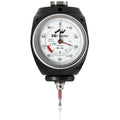
To measure the hardness of a specific type of rubber, an internationally accepted device called a Durometer is used. Rubber hardness is an extremely important parameter related to the flexibility (elasticity) of the material, since it is important how deeply the measuring device can penetrate the surface. The durometer essentially helps us determine how much the tested rubber can resist the pressure applied to its surface, but it does not help us determine how quickly it can wear, crack, or be scratched.

Rubber is a material that can be found in a wide range of products, i.e. elastic materials in industrial production, car tires, kitchen utensils, shoe soles, different polymers, etc.
| Type | Applications |
|---|---|
| A | Soft vulcanized rubber, natural rubber, nitrile, thermoplastic elastomers, flexible polycrystalline materials, wax, and leathers. |
| C | Medium-hard rubber, thermoplastic elastomers, medium-hard plastics and thermoplastics |
| D | Hard rubber, thermoplastic elastomers, harder plastics and rigid thermoplastics |
| O | Extremely soft rubber, thermoplastic elastomers, sponge, extremely soft plastics and thermoplastics, foams, low-density fabric wraps, human and animal tissues. |
The measurement result also depends not only on the material itself but also on the size of the indenter that penetrates the surface and the duration of the test, since the hardness at the beginning may be different from the result obtained after indentation into the surface and the time it remains within the material. For more accurate results, the surface should be flat.
There are mainly two scales used for elastomer measurements: Shore A, which is suitable for soft elastomers, and Shore D for harder ones.
There is another scale, Shore O, which can be used for very soft materials.
The numerical values for the above scales range from 0 to 100 but overlap, as shown in Table 1.
The sample whose surface is tested must have a certain thickness (at least 6.4 mm).
TABLE 1: Shore method/Spring force/ Indenter type/Specimen thickness/Measurement range
The Shore hardness value can range from 0 to 100. The maximum penetration for each scale is 0.097-0.1 inches (2.5-2.54 mm). This value corresponds to the minimum Shore hardness: 0. The maximum hardness value of 100 corresponds to zero penetration.

Figure 1: The indenters for Shore A and Shore D durometers.
.
Hardness is inversely proportional to penetration and depends on the elasticity and viscoelastic behavior of the material. The geometry of the indenter and the applied force affect the measurements, so there is no simple relationship between measurements taken with one type of durometer and those taken with another type of durometer or other instruments used to measure hardness.
Operating principle
To understand Table 1, we should look at a few things about how the Shore durometer works. The principle used to measure hardness is based on measuring the resistance force to the penetration of a pin into the test material under a known spring load. The penetration value (maximum 2.5 mm) is converted into a hardness reading on a 100-unit scale. The measured hardness is determined by the penetration depth of the indenter under a load. The forces that appear during penetration of the pin into the surface of the specimen are shown in the image below.

Figure 2: Operating principle of a hardness tester using the Shore method.
According to ASTM D 2240, readings below 10 and above 90 should not be considered reliable and must be rejected. Therefore, it is important to select the appropriate scale that will provide results between 10-90 units.
Applications

Figure 3 : Shore hardness scales for various commercial materials.
TABLE 2: Materials and corresponding Shore methods for calculating their hardness.


← All guides



Related guides

Μη Καταστροφικός ΈλεγχοςΣκληρότητα ΜετάλλωνOverview of hardness testing methods and choosing an instrument.
Μη Καταστροφικός ΈλεγχοςΜεθοδος Μέτρησης Σκληρότητας BrinellThe Brinell method — principle, applications and the HB scale.

Μη Καταστροφικός ΈλεγχοςΜεθοδος Μέτρησης Σκληρότητας VickersThe Vickers method — operating principle and the HV scale.
Μη Καταστροφικός ΈλεγχοςRockwell C Κλίμακα ΣκληρότηταςThe Rockwell C scale (HRC) for hard metals.
Μη Καταστροφικός ΈλεγχοςΠαχύμετρα ΕπικαλύψεωςMeasuring paint and coating thickness on metal.
Μη Καταστροφικός ΈλεγχοςΠαχύμετρα ΥπερήχωνMeasuring material thickness with ultrasound from one side.
Μη Καταστροφικός ΈλεγχοςΜετρητές ΔόνησηςChecking machine vibration for preventive maintenance.
Μη Καταστροφικός ΈλεγχοςΤραχυμέτραMeasuring surface roughness (Ra, Rz) to standards.