info@organametrisis.gr
210 2231624
210 2231624

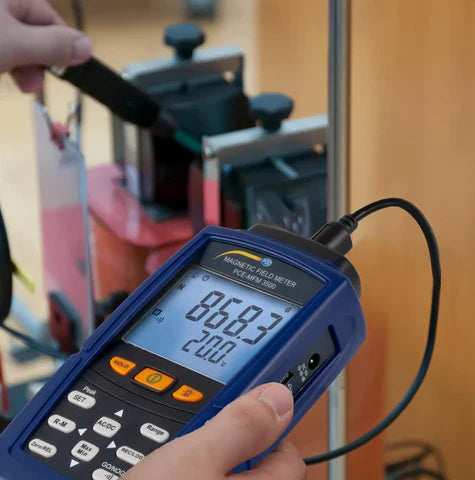
A photometer is a highly sensitive electronic measuring device used to monitor and measure the lighting of any area. Most light measuring devices are small in size, are simple to operate, and are equipped with an easy-to-read illuminated display made of special glass. | Typically, a heavy-duty housing protects the light sensor inside the photometer from damage. A photometer is used to measure illuminance in lux (lx), in foot-candles (fc), or in candela per square meter (cd/m²).
Some photometers are equipped with internal memory or a data logger for recording and storing measurements. Measuring light intensity is becoming increasingly important in the workplace due to safety concerns. Light measurement is also necessary to determine the best position and angle when installing and adjusting solar panels.

Lux
The lux (symbol: lx) is the SI unit of illuminance that measures luminous flux per area. It is used in photometry as a measure of the intensity incident on or passing through a surface as perceived by the human eye. It is analogous to the radiometric unit watt per square meter, but with the power at each wavelength weighted according to the luminosity function, a standardized model of human visual perception.
| Illuminance (lux) | Surfaces illuminated by |
|---|---|
| 0.0001 | Moonless, overcast night sky |
| 0.05–0.3 | Full moon on a clear night |
| 20–50 | Public areas with a dark environment |
| 50 | Living room lighting |
| 80 | Lighting in an office corridor |
| 100 | Very dark day |
| 150 | Train station platforms |
| 320–500 | Office lighting |
| 400 | Sunrise or sunset on a clear day. |
| 1000 | Cloudy day - typical TV studio lighting |
| 10,000–25,000 | Full daylight (not direct sun) |
| 32,000–100,000 | Direct sunlight |
Illuminance (Illuminance) is a measure of how much luminous flux is spread over a given area. One can think of luminous flux (measurable in lumens) as a measure of the total “amount” of visible light present, and illuminance as a measure of the intensity of illumination on a surface. A given amount of light will illuminate a surface more dimly if it has been spread over a wider area, so illuminance is inversely proportional to area.
One lux is equal to one lumen per square meter
A flux of 1,000 lumens, concentrated in an area of one square meter, equals an illuminance of 1,000 lux. However, the same 1,000 lumens spread over an area of ten square meters produce a reduced illuminance equal to 100 lux.
Achieving an illuminance of 500 lux in a kitchen can be achieved with a luminaire with a fluorescent lamp that produces 12,000 lumens. To illuminate a factory floor with an area 12 times larger than the kitchen would require 12 such luminaires. Therefore, to illuminate a larger area at 500 lux, a greater number of lumens is required.
As with other SI units, system prefixes can also be used here. For example, 1 kilolux (klx) equals 1,000 lux.

Relationship between illuminance and radiation
Like all photometric units, lux has a corresponding “radiometric” unit. The difference between the photometric unit and the corresponding radiometric unit of lux is that its radiometric unit is based on physical power, with all wavelengths weighted equally, while photometric units take into account the fact that the human visual system is more sensitive to some wavelengths than others and therefore each wavelength is given a different weight.
The peak of the luminosity function is at 555 nm (green); the eye’s visual system is more sensitive to light of this wavelength than to any other. For monochromatic light of this wavelength, the irradiance required to produce one lux is 1.464 mW/m2. That is, one can achieve 683.002 lux per W/m2 (lumens per watt) at this wavelength. Other wavelengths of visible light produce fewer lumens per watt. The luminosity function drops to zero for wavelengths outside the visible spectrum.
For a light source with mixed wavelengths, the number of lumens per watt can be calculated using the luminosity function. To appear reasonably “white,” a light source cannot consist exclusively of green light, to which the eye’s photoreceptors are most sensitive, but must include a rich mixture of red and blue wavelengths, to which they are less sensitive.
This means that white (or off-white) light sources produce far fewer lumens per watt than the theoretical upper limit of 683 lumens per watt. The ratio between the actual number of lumens per watt and the theoretical maximum is expressed as a percentage known as luminous efficiency. For example, a typical incandescent lamp has a luminous efficiency of only about 2%.
In practice, each eye differs in its perception of the luminosity function. However, photometric units are precisely defined and are exactly measurable. They are based on a commonly accepted standard luminosity function that is based on measurements of the spectral characteristics of visual photoreception in many human eyes.

Tips for buying a light meter
It is bright, but how bright is it? What is the color of the light? Both of these questions come up again and again now that conventional lamps are increasingly being replaced by LEDs. A photometer can help answer these questions. These photometers have different sensors, and some have additional functions.
The standard light meter is equipped with a photocell for analog acquisition of light intensity, which is then displayed on the screen as an illuminance value.
To ensure that the light incident on the photocell of the photometer is uniform, the sensor is located behind a diffusing dome. All these light meters operate according to the CIE standard. They can measure the illuminance of any visible light source. This means that any light meter can measure conventional lamps as well as LED lamps, except for blue light or blue LED, which cannot be measured due to the wavelength of the light.
Photometers with additional measurement functions such as measuring color temperature or the color of the light require a different type of sensor. A range of modern CCD sensors measures illuminance, wavelength, etc. of the light. These sensors in the photometer are similar to an image sensor in a digital camera. These modern spectrometers can measure the exact composition of the light. Photometers with a spectrophotometer function or with a CCD pixel sensor can measure all types of light, even blue LED.
Light meters can also have different accuracy and be based on different measurement standards. A standard light meter will have accuracy class B. Numerically, this is an accuracy of ± 8% of the light reading.
Many photometer models are equipped with an interface that allows the user to transfer data from a series of measurements to a computer. In addition, some light meters have internal memory to store measurement values.
Various measurement accessories, which are optionally available or included in the standard package of the light meter, allow the user to measure the illuminance of screens or other light sources.
Types of indoor lighting
Humanity has developed a variety of light sources to illuminate the dark. Recommendations for indoor lighting depend on consumer preference and the location of the light source (e.g., home, office, school, parking area, street, theater hall or hospital room, operating room, etc.).
One of the most popular achievements in modern lighting technology is the diode (LED). LED lights can be found almost anywhere, indoors and outdoors, and are available in various sizes and colors. The main advantages of LEDs are low energy consumption and long service life. These features make LEDs very attractive to consumers. LED lamps do not emit as much heat as incandescent lights. Even when an LED lamp is on, there is no risk of burning the skin if contact is made with the lamp. In addition, thanks to their epoxy lenses, LEDs are not very fragile. Although LEDs are quite popular nowadays, other types of indoor lighting are still widely used.
The aforementioned incandescent light has been used for decades in many indoor lighting applications. Incandescent lamps produce a soft and pleasant glow. This is why the incandescent lamp is still found in residences, even though incandescent lamps consume much more energy. Incandescent lamps heat up over time, and although the additional heat can help keep indoor temperatures warmer during the winter months, careful handling of lamps that are recently or currently lit is required, because contact with the lamps can burn the skin.
Another alternative to incandescent lighting is halogen lighting. Sometimes halogen lamps are selected for use in desk lamps, inside and under cabinets, and in various wall fixtures. Halogen lights are small in size, contain halogen and inert gas, and offer a higher level of brightness and longer service life.
Integrated compact fluorescent lamps (CFL) resemble incandescent lamps, as both types of lamps have the same base. Integrated CFLs can be used in many standard incandescent fixtures. The difference between integrated CFL lamps and incandescent lamps is that the service life is much longer (on average 8 - 13 hours) and energy consumption is lower by ¾ for integrated CFL lamps. From an aesthetic point of view, the tube design of integrated CFL lamps looks very different from the egg-shaped design of incandescent lamps. For this reason, some consumers prefer to use incandescent lamps in fixtures.
Traditionally, when one thinks of fluorescent lighting, one imagines the long tube-shaped lamps often used in industrial-looking light fixtures. Since these large fluorescent lamps produce very intense light, they are often referred to as daylight lamps. Because there is some amount of mercury in these types of lamps, the lamps must be handled and disposed of carefully.
Finally, neon lighting can be found in some indoor environments. Neon lighting consists of electrified glass tubes filled with diluted neon or other gases. The type of gas used in the tube determines the color of the light. Neon lights can be used for decorative lighting in bars and nightclubs as well as for small indicator lights in electronic displays.
Therefore, the selection of indoor lamps depends largely on the intended application. However, whether a lamp is required for ambient lighting, spotlighting, or a specific use, factors such as service life, energy consumption, aesthetics, and price are almost always considered. In addition, special functions such as dimming are often added. Only after analyzing all required (and desired) lighting parameters can the best (most suitable) indoor lighting solution be identified. A standard light meter is a useful tool for evaluating indoor lighting conditions, especially those involving incandescent lamps and fluorescent lamps. Finally, when evaluating LED lighting indoors, a dedicated LED photometer is recommended.