info@organametrisis.gr
210 2231624
210 2231624

The microscope is a device used to see things that are too small to be seen with the naked eye. There are many types of microscopes. The most common type is the optical microscope.
Digital microscopes
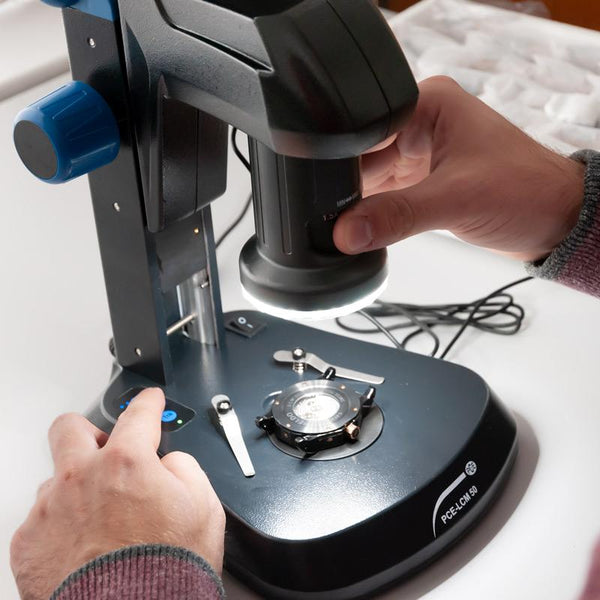
In industry, digital microscopes are becoming increasingly popular. Instead of working with eyepieces, you can now transfer the image directly to a digital screen and view it there. This facilitates teamwork and decisions can be made more efficiently. Digital processing of the displayed images is also simplified. Depending on the microscope equipment, images and videos can be saved to the storage medium or directly to the computer. Meanwhile, measurements and topography are also possible via suitable software, which is also used for internal reports. In this way, especially in the field of quality assurance, defective products can be sorted out or the desired quality can be ensured.
Magnification
To select the right microscope, it must be clear how high the magnification of the objects to be tested needs to be. In addition, it is necessary to note that for upright microscopes, the sample size, working distance, and lenses are directly related to each other. This means that the higher the magnification of the lenses, the smaller the working distance becomes. This also means that the sample is constrained by its dimensions in relation to the microscope’s working distance. In order to obtain clear images with optimal resolution, uniform illumination is important, which is provided by default in microscopes by the built-in halogen or LED lamps. If this is not sufficient, illumination can be increased via external lighting units.

USB microscopes and 3D microscopes
A visual inspection of a large sample within production processes would not be possible for most microscopes due to their design. Due to their small size, for example, USB microscopes are used. They are connected via a USB cable to a computer. The devices can also be mounted on functional tripods so that both hands are free for adjustments. If two-dimensional viewing is not sufficient, so-called 3D Microscopes allow a completely new type of representation. At a 45° angle, you have a spherical view (360°) of your test object. This innovative view is particularly practical in the inspection of components when it comes to identifying and documenting defects and damage.