info@organametrisis.gr
210 2231624
210 2231624

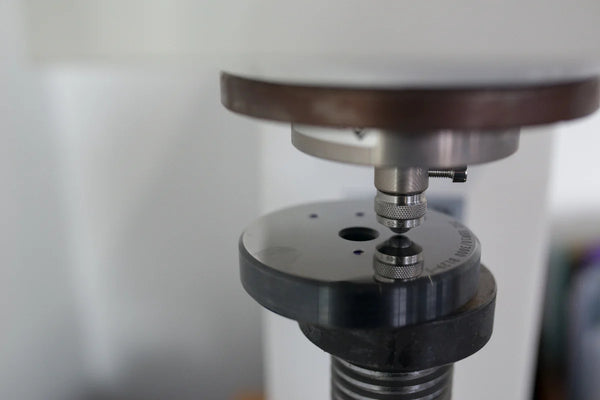
Hardness is not a fundamental property of a material, but a quantity that indicates how mechanically resistant a material (test piece) is to mechanical penetration by another harder body (indenter). Precisely because it is not a fundamental quantity, different methods have been developed over the years with the aim of determining it. Initially, the selection of the method depends on the material of the specimen. Then, 1) the magnitude of the force, 2) the time for which the force will be applied to the specimen, and 3) the geometry of the indenter must be determined—parameters that are defined by the thickness of the material.
The methods are distinguished based on what they measure during the hardness testing of a specimen:· Measurement of the penetration depth (depth measurement method: Rockwell, Superficial Rockwell, Shore)· Measurement of the indentation area (optical measurement method:Vickers, Brinell, Knoop) caused by the indenter.· Measurement of the rebound velocity of a ball (Leeb)· With infrared radiation (UCI method)
hardness testers using the rebound method operate in a slightly different way. Although the size of the indentation made on the specimen is related to the hardness of the material even in this case, it is measured indirectly via the energy loss of a so-called impact body.
A mass is accelerated toward the surface of the specimen and impacts it at a defined velocity. The impact creates plastic deformation on its surface, i.e., an indentation, due to which the impact body loses part of its initial velocity—or energy. It will lose more velocity when a larger indentation is created in the softer material. Technically, this measurement principle is implemented by means of an impact body that has a spherical tungsten carbide tip, which is accelerated onto the test surface by a spring force.
The velocities after and before the impact are measured indirectly. Inside the impact body there is a small permanent magnet (Figure 1) which generates an induced voltage as it passes through a coil, which is proportional to the velocity. More specifically, as the impact body moves toward the test piece, the magnet contained inside the impact body generates a signal in a coil that surrounds the guide tube. After the impact, it changes direction, causing a second signal in the coil. The instrument calculates the hardness value using the ratio of the voltages and analyzes their phases to automatically compensate for changes in the orientation of the impact body.

The inventor of this method, D. Leeb, defined his "own" hardness value, the Leeb hardness value. The Leeb hardness value, HL, is calculated from the ratio of the impact and rebound velocity and is equal to the ratio of the rebound velocity (vR) to the impact velocity (vI) multiplied by 1000. Finally, the way the velocities are calculated makes it possible to take measurements in any direction without needing to take into account a correction factor for the force of gravity.

We can now ask: "Who wants to measure the hardness value on the Leeb scale?" The answer is that in practice anyone who uses the rebound method to measure hardness does so for the convenience and portability of the method. However, almost no user states the Leeb hardness value HL in their specifications or test reports. Therefore, these instruments are equipped with direct conversion from the Leeb scale to the other hardness scales (HV, HB, HS, HRC, HRB, N / mm2).
Brinell Hardness Measurement Method
Vickers Hardness Measurement Method
Shore Durometer Hardness Scale
As in standard Vickers or Brinell hardness tests, the question regarding the size of the test indentation in the material resulting from a specific test load also arises with the Vickers hardness test according to the UCI (Ultrasonic Contact Impedance) method. However, the diagonals of the test indentation, which must be known to determine the Vickers hardness value, are not evaluated visually as usual, but the indentation area is detected electronically by measuring the shift of an ultrasonic frequency
A UCI probe typically consists of a Vickers diamond attached to the end of a metal rod (Figure 3). This rod is excited into longitudinal vibration at approximately 70 kHz via the piezoelectric transducer.

Figure 3: (Left) The parts that make up the probe of a UCI hardness tester. (Right) The cross-section of the spring that calculates the frequency difference during the longitudinal vibration of the rod.
When the test load is applied, a shift occurs in the vibration frequency of the rod as the diamond penetrates into the material. This frequency change will be greater when the test indentation becomes larger, i.e., when the diamond penetrates deeper into a "soft" material. Accordingly, a smaller frequency shift is produced by hard test materials. In this case, the diamond penetrates slightly into the material and leaves a small indentation.
This is the secret of the UCI hardness test: that the frequency shift is proportional to the size of the indentation left by the Vickers diamond on the surface of the specimen.
The UCI hardness measuring instrument continuously monitors the frequency, performs the calculations, and instantly displays the hardness value. The frequency shift, however, also depends on Young's modulus of elasticity, which has a specific value for each material. For the practical application of the UCI method, Young's modulus must be taken into account. The instrument must be calibrated when the hardness of different materials with different Young's modulus values must be determined.
Conversion table of HB, HRC, HRB and HV values.
TABLE 1: Conversion of HB, HRC, HRB and HV values according to ASTM E140
|
Brinell Hardness HB |
Rockwell HRC |
Rockwell HRB |
Vickers HV |
N/mm² |
|---|---|---|---|---|
| 800 | 72 | |||
| 780 | 71 | |||
| 760 | 70 | |||
| 752 | 69 | |||
| 745 | 68 | |||
| 746 | 67 | |||
| 735 | 66 | |||
| 711 | 65 | |||
| 695 | 64 | |||
| 681 | 63 | |||
| 658 | 62 | |||
| 642 | 61 | |||
| 627 | 60 | |||
| 613 | 59 | |||
| 601 | 58 | 746 | ||
| 592 | 57 | 727 | ||
| 572 | 56 | 694 | ||
| 552 | 55 | 649 | ||
| 534 | 54 | 120 | 589 | |
| 513 | 53 | 119 | 567 | |
| 504 | 52 | 118 | 549 | |
| 486 | 51 | 118 | 531 | |
| 469 | 50 | 117 | 505 | |
| 468 | 49 | 117 | 497 | |
| 456 | 48 | 116 | 490 | 1569 |
| 445 | 47 | 115 | 474 | 1520 |
| 430 | 46 | 115 | 458 | 1471 |
| 419 | 45 | 114 | 448 | 1447 |
| 415 | 44 | 114 | 438 | 1422 |
| 402 | 43 | 114 | 424 | 1390 |
| 388 | 42 | 113 | 406 | 1363 |
| 375 | 41 | 112 | 393 | 1314 |
| 373 | 40 | 111 | 388 | 1265 |
| 360 | 39 | 111 | 376 | 1236 |
| 348 | 38 | 110 | 361 | 1187 |
| 341 | 37 | 109 | 351 | 1157 |
| 331 | 36 | 109 | 342 | 1118 |
| 322 | 35 | 108 | 332 | 1089 |
| 314 | 34 | 108 | 320 | 1049 |
| 308 | 33 | 107 | 311 | 1035 |
| 300 | 32 | 107 | 303 | 1020 |
| 290 | 31 | 106 | 292 | 990 |
| 277 | 30 | 105 | 285 | 971 |
| 271 | 29 | 104 | 277 | 941 |
| 264 | 28 | 103 | 271 | 892 |
| 262 | 27 | 103 | 262 | 880 |
| 255 | 26 | 102 | 258 | 870 |
| 250 | 25 | 101 | 255 | 853 |
| 245 | 24 | 100 | 252 | 838 |
| 240 | 23 | 100 | 247 | 824 |
| 233 | 22 | 99 | 241 | 794 |
| 229 | 21 | 98 | 235 | 775 |
| 223 | 20 | 97 | 227 | 755 |
| 216 | 19 | 96 | 222 | 716 |
| 212 | 18 | 95 | 218 | 706 |
| 208 | 17 | 95 | 210 | 696 |
| 203 | 16 | 94 | 201 | 680 |
| 199 | 15 | 93 | 199 | 667 |
| 191 | 14 | 92 | 197 | 657 |
| 190 | 13 | 92 | 186 | 648 |
| 186 | 12 | 91 | 184 | 637 |
| 183 | 11 | 90 | 183 | 617 |
| 180 | 10 | 89 | 180 | 608 |
| 175 | 9 | 88 | 178 | 685 |
| 170 | 7 | 87 | 175 | 559 |
| 167 | 6 | 86 | 172 | 555 |
| 166 | 5 | 86 | 168 | 549 |
| 163 | 4 | 85 | 162 | 539 |
| 160 | 3 | 84 | 160 | 535 |
| 156 | 2 | 83 | 158 | 530 |
| 154 | 1 | 82 | 152 | 515 |
| 149 | 81 | 149 | 500 | |
| 147 | 80 | 147 | 490 | |
| 143 | 79 | 146 | 482 | |
| 141 | 78 | 144 | 481 | |
| 139 | 77 | 142 | 480 | |
| 137 | 76 | 140 | 475 | |
| 135 | 75 | 137 | 467 | |
| 131 | 74 | 134 | 461 | |
| 127 | 72 | 129 | 451 | |
| 121 | 70 | 127 | 431 | |
| 116 | 68 | 124 | 422 | |
| 114 | 67 | 121 | 412 | |
| 111 | 66 | 118 | 402 | |
| 107 | 64 | 115 | 382 | |
| 105 | 62 | 112 | 378 | |
| 103 | 61 | 108 | 373 | |
| 95 | 56 | 104 | ||
| 90 | 52 | 95 | ||
| 81 | 41 | 85 | ||
| 76 | 37 | 80 | ||
|
Brinell HB |
Rockwell HRC |
Rockwell HRB |
Vickers HV |
N/mm² |
|
3000kg 10mm Ball |
150kg Brale |
100kg 1/16" Ball |
Diamond Pyramid 120kg |
Tensile strength (A |