








































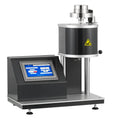


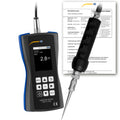
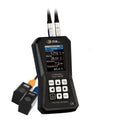
































































































Dynamometers Newtonmeters
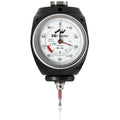
The dynamometer is a device used to measure the applied compressive or tensile force (push / pull) or to determine torque (torque).
The internationally used unit for force is the Newton. In everyday life, in medicine, and also for load specifications, however, the term weight is usually used with specifications in kilograms. For this reason, there are many force gauge models that display the measured values in grams or kilograms. In English, the force reference is indicated with an appended f for force, where it is not kg but kgf. A force of one kilogram (kg or kgf) corresponds to approximately 10 (9.81) newtons, and one newton to approximately 100 (102) grams.
When selecting a dynamometer, you must consider how the force is applied. Tension is the pull force, while compression is the push force. Another common force measurement is torque. Torque is the force that results from rotation. For torque measuring instruments, visit the torque meters.
Portable or Fixed
The answer to this question depends largely on the application. If you want to use the dynamometer to collect occasional measurements for quality assurance, a portable device is sufficient. If you want a more accurate and repeatable force test, it is better to use a fixed force test stand with your dynamometer. In addition to providing stability, a fixed force test stand, also called a universal testing machine (UTM), can be equipped with an RS-232 interface or a USB port, allowing connection to a computer.

Measuring Range
For safety reasons, you should choose a dynamometer that can cover up to the maximum expected measurement. Then, a buffer may need to be considered, if the required measurement accuracy allows it. In addition, the risks that may arise during force measurement should be identified and eliminated accordingly in advance. For example, if during a tensile force measurement there is a risk of twisting of the test material, the force measuring device must be secured using a clamp to prevent injury.
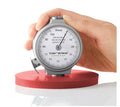
For applications that require small forces, a simple and cost-effective force measuring device is a spring scale. A spring scale measures weight or force, usually in grams (g), kilograms (kg), pounds (lbs) or/and Newton (N), when an object is hung from the scale hook.
Another force measuring device with a mechanical measurement principle is a hydraulic dynamometer. A hydraulic dynamometer uses a hydraulic fluid to measure forces. Hydraulic force sensors are designed for much larger force measuring ranges compared to spring scales. However, the disadvantages of hydraulic force meter devices are lower measurement accuracy, lower measurement resolution, and lack of measurement traceability. For these reasons, digital force measuring devices are mainly used.

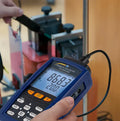
A digital force gauge consists of two important elements: the sensor and the meter. In digital force gauge devices with a lower measuring range, the sensor is often installed internally. For larger measuring ranges, the sensor is connected externally to the meter. Many digital force gauge products are multi-purpose and will measure both tensile and compressive forces, among other parameters, such as rotational speed and three-axis vibration. There is no single sensor that is suitable for all measurement tasks. Thus, these multi-purpose digital force gauge devices will often be supplied with adapters and/or will be programmed to perform mathematical measurement conversions.
An important parameter for a digital force gauge is the maximum possible sampling rate. The sampling rate is the frequency at which the transmitter checks the force sensor. It is often indicated as a number of Hz. 1000 Hz means that the force sensor is queried 1000 times per second by the transmitter and the transmitter can update the measurement data 1000 times per second. Low-cost force gauges have only a sampling rate of 2 Hz, which is sufficient for a slow force measurement, but is certainly unsuitable for a tear test.
The greater the maximum load of the sensor, the lower the measurement accuracy of the sensor. Therefore, a compromise must be achieved here. Each force gauge will have its own accuracy specifications that depend on the range being measured. Typically, a higher-accuracy measuring instrument will come with a higher price, so it is important to consider practicality as well as accuracy.
Examples of specific applications

Whether in high-voltage lines or overhead railway lines, in buildings, bridges, cable cars, elevators, cranes, or other machinery, tests before and after installation are intended to ensure that cables and ropes can safely fulfill their functions. New ropes are tested before installation with a tensile testing machine or with a suitable pressure gauge on special fittings. ISO 2307:2019 and EN ISO 2307:2019 and, based on this, DIN EN ISO 2307: 2019-12 specify, among other things, the methods for measuring the breaking force and the elongation of the rope under tensile load. For tensile force measurements on tensioned wires or ropes, a mobile force gauge specially designed for measuring rope force can be used, which is set up so that the rope is guided over three rollers of the gauge. These special rope tension meters are available for different force ranges, rope diameters, and with different lengths of the measuring distance. However, free access and sufficient space are always required for mounting the measuring device.