
Measuring Wedges
13 από 13 products
Filters
Material


4206-1
Hole Gauge Telescopic Set 8-150mm
From Original price €0,00
Original price
€0,00
€38,20€47,37
without VAT
From €38,20€47,37
Current price
€38,20€47,37
Available
The small hole gauge is used for measurements in small holes. It is usually used in combination with a micrometer, 6 small hole gauges per set ...
View full details
4209-1
Hole Gauge Long 8-150 mm
From Original price €0,00
Original price
€0,00
From €11,20€13,89
without VAT
From €11,20€13,89
Current price
€11,20€13,89
Available
For quick measurement of the internal diameter of deep holes and groove width. chrome finishing.

4208
Hole Gauge Telescopic Set 3-13 mm
From Original price €0,00
Original price
€0,00
€27,10€33,60
without VAT
From €27,10€33,60
Current price
€27,10€33,60
Available
4 gages per set For small holes, slots, and grooves, etc. Chrome finish.


5163
Steel Hole Gauge Set 0.45-3 mm - Jet Gauge
From Original price €0,00
Original price
€0,00
€10,70€13,27
without VAT
From €10,70€13,27
Current price
€10,70€13,27
Available
Steel hole gauges in a plastic case Marked nominal size Frame with locking screw

4833-1
Wedge Hole Gauge
From Original price €0,00
Original price
€0,00
From €9,20€11,41
without VAT
From €9,20€11,41
Current price
€9,20€11,41
Available
They measure the opening, the slot width, the hole diameter, etc. Diameter correction table on the back (only for 4833-1, 4833-2) Made of stainles...
View full details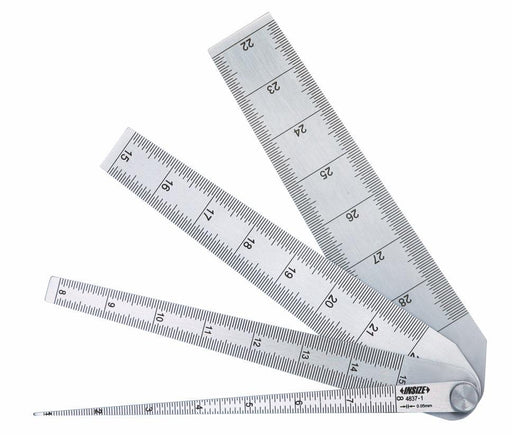
4837-1
Hole Gauge Taper 1-29 mm
From Original price €0,00
Original price
€0,00
€49,60€61,50
without VAT
From €49,60€61,50
Current price
€49,60€61,50
Available
Includes 4 pcs (1-8 mm, 8-15 mm, 15-22 mm, 22-29 mm) They measure the opening, the slot width, the hole diameter, etc. Diameter correction table o...
View full details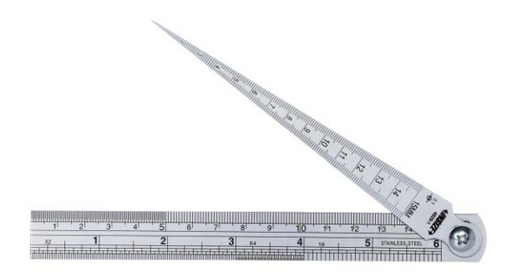
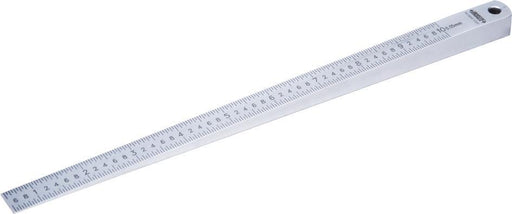
4829-1
Hole Gauge Wedge 0.8-15 mm Scale 150 mm
From Original price €0,00
Original price
€0,00
€10,00€12,40
without VAT
From €10,00€12,40
Current price
€10,00€12,40
Available
Diameter correction table on the taper gage backMade of stainless steel
4630-1
Measuring Taper - Inox
From Original price €0,00
Original price
€0,00
From €38,90€48,24
without VAT
From €38,90€48,24
Current price
€38,90€48,24
Available
For quick width measurement from gaps Chromed reading surface Made of stainless steel.


0599102
Small Hole (Nozzle) Gauge 0-5 mm
From Original price €0,00
Original price
€0,00
€83,00€102,92
without VAT
From €83,00€102,92
Current price
€83,00€102,92
Available
With 1:10 taper Graduation 0.01mm Special steel

0600
Tapered Hole Gauge 0.1 mm
From Original price €0,00
Original price
€0,00
€66,00€81,84
without VAT
From €66,00€81,84
Current price
€66,00€81,84
Available
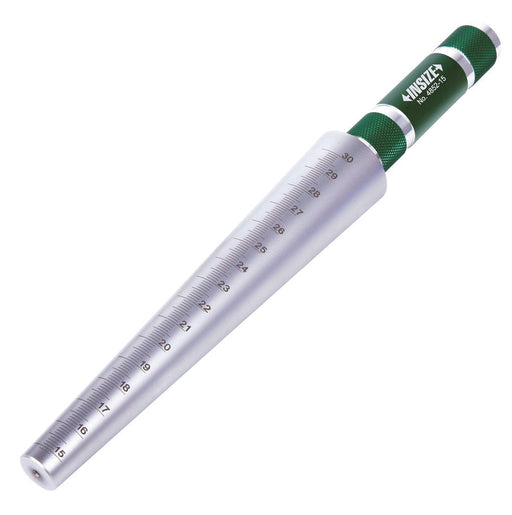
4852
Tapered Hole Gauge
From Original price €0,00
Original price
€0,00
From €51,30€63,61
without VAT
From €51,30€63,61
Current price
€51,30€63,61
Available
Quick hole diameter measurement Hardened steel, HRC 50-58 Satin chrome-plated surface Aluminum handle

4855
Small taper bore gauge 0.1-5mm
From Original price €0,00
Original price
€0,00
€147,00€182,28
without VAT
From €147,00€182,28
Current price
€147,00€182,28
5-8 Working days
Specifications Manufacturer: INSIZE Type: Small taper bore gauge Catalog code: 4855-5 Measuring range: 0.1–5mm Graduation: 0.01mm Accu...
View full details
1160-10
Digital Taper Slot Gage
From Original price €0,00
Original price
€0,00
From €417,00€517,08
without VAT
From €417,00€517,08
Current price
€417,00€517,08
Available
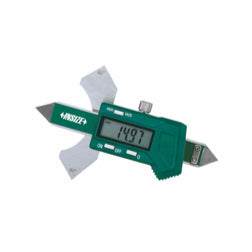
Measuring opening, slot width Reading: 0.01mm/0.0005" Buttons: on/off, zero, mm/inch Automatic power off Battery CR2032 Made of stainless steel
Measuring wedges are practical inspection tools used to quickly verify gaps, clearances, and tolerances in locations where calipers or micrometers cannot reach. They are ideal for setup checks, alignment verification, and on-the-spot dimensional control during assembly, maintenance, or production, helping confirm whether a clearance is within specification without complex fixturing.
In this collection you’ll find measuring wedges from Insize, designed with clear graduations and stable geometry for repeatable readings. Options are available in different ranges and scales, with fine taper angles to support precise interpretation of the insertion depth. Selection typically depends on the target clearance, contact surface conditions, and the level of traceability required in your inspection workflow.
Common users include machinists, maintenance technicians, and QC/QA teams in applications such as guideway adjustment, clearance checks in assemblies and housings, and inspection tasks across metal fabrication, industrial automation, and general mechanical engineering.
Manufacturers


