
Ultrasonic Thickness Gauges
15 από 15 products
Filters
Data Out


ISU-100D
Ultrasonic Caliper
From Original price €0,00
Original price
€0,00
€498,00€617,52
without VAT
From €498,00€617,52
Current price
€498,00€617,52
Available
Range: 0.8-300 mm Reading: 0.01 mm (range Repeatability: 0.03 mm (range Accuracy: ±0.04 mm (range Measures thickness from one side of the objec...
View full details
ISU-200D
Ultrasonic Thickness Gauge - Accepts Extra Sensors
From Original price €0,00
Original price
€0,00
€751,00€931,24
without VAT
From €751,00€931,24
Current price
€751,00€931,24
5-8 Working days
Range: 0.8-300 mm (with the standard N05 probe) Reading (resolution): 0.01 mm Accuracy: ±0.05 mm (H<10 mm), ±(0.05 + H×0.001) mm (H>10 mm), ...
View full details
ISU-250C
Ultrasonic Caliper - Accepts Extra Sensors
From Original price €0,00
Original price
€0,00
€1.379,00€1.709,96
without VAT
From €1.379,00€1.709,96
Current price
€1.379,00€1.709,96
5-8 Working days
Reading: 0.01mm (range<100mm), 0.1mm (range≥100mm) Repeatability: 0.03mm (range<100mm), 0.1mm (range≥100mm) Speed: 1000-9999 m/s Accuracy: ...
View full details

PCE-TG 300-P5EE
Ultrasonic Thickness Gauge (ignores paint)
From Original price €0,00
Original price
€0,00
€1.433,00€1.776,92
without VAT
From €1.433,00€1.776,92
Current price
€1.433,00€1.776,92
Available
Measures up to 600 mmPulse-echo or echo-echo modeFor all homogeneous materialsPrinting via BluetoothUSB connectionThe PCE-TG 300-P5EE is an ultraso...
View full details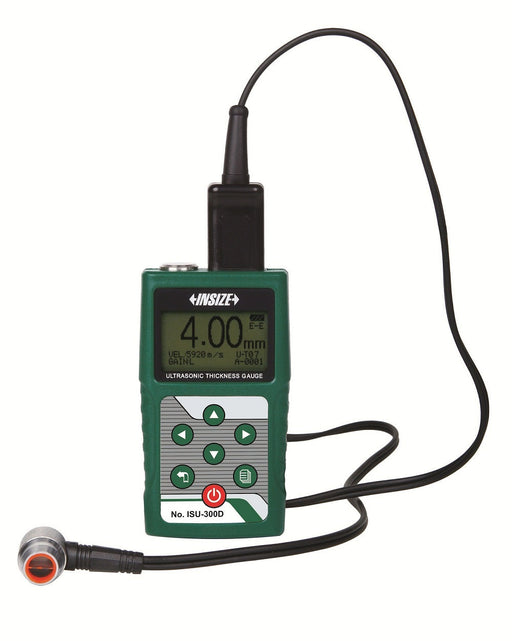
ISU-300D
Ultrasonic Caliper - Through Coating (Ignores Paint) - Accepts Extra Sensors
From Original price €0,00
Original price
€0,00
€2.278,00€2.824,72
without VAT
From €2.278,00€2.824,72
Current price
€2.278,00€2.824,72
Available
Measurement range: E-E mode: coating thickness 0~1mm, substrate thickness 4~25mm T-E mode substrate thickness 1.5 ~ 200mm Reading: 0.01mm (range&...
View full details
ISU-800D
Precision Ultrasonic Caliper - Through Coating (Ignores Paint) - Accepts Extra Sensors
From Original price €0,00
Original price
€0,00
€3.590,00€4.451,60
without VAT
From €3.590,00€4.451,60
Current price
€3.590,00€4.451,60
5-8 Working days
Real-time temperature compensation eliminates error caused by temperature fluctuations Support for both single and double elementary structur...
View full details
ISU-720D
Ultrasonic Caliper (A - B Scan) - Accepts Extra Sensors
From Original price €0,00
Original price
€0,00
€4.680,00€5.803,20
without VAT
From €4.680,00€5.803,20
Current price
€4.680,00€5.803,20
Upon request
Two measurement methods: Echo-Echo (E-E) and Transmit-Echo (T-E) E-E: Measurement of substrate thickness without being affected by non-metallic ...
View full details
ISU-700D
Ultrasonic Thickness Gauge (A - B Scan) for thin workpieces
From Original price €0,00
Original price
€0,00
€4.904,00€6.080,96
without VAT
From €4.904,00€6.080,96
Current price
€4.904,00€6.080,96
Upon request
Specifications: Measurement range: T-E mode (Transmit-echo): 1.5–20mm E-E mode (Echo-echo): 0.2–10mm Resolution: 0.1/0.01/0.001mm Accuracy...
View full details
ISU-710D
Ultrasonic Thickness Gauge (A - B Scan) for thick workpieces made of organic materials
From Original price €0,00
Original price
€0,00
€4.704,00€5.832,96
without VAT
From €4.704,00€5.832,96
Current price
€4.704,00€5.832,96
Upon request
Specifications - ISU-710D Ultrasonic Thickness Gauge Main Features: Designed for thick pieces of organic materials. A-scan and B-scan functions: ...
View full details
ISU-810D
Ultrasonic Caliper (A - B Scan) - Accepts Extra Sensors
From Original price €0,00
Original price
€0,00
€3.906,00€4.843,44
without VAT
From €3.906,00€4.843,44
Current price
€3.906,00€4.843,44
Upon request
Technical Specifications Measurement range: Refer to sensor specifications Reading: 0.1/0.01mm Accuracy: ±0.05mm (H≤10mm), ±(0.05%+0.01)mm (H...
View full details
EMU-S340
Electromagnetic Ultrasonic Pen Type Caliper (Penetrates rust max 4 mm)
From Original price €0,00
Original price
€0,00
€13.012,00€16.134,88
without VAT
From €13.012,00€16.134,88
Current price
€13.012,00€16.134,88
5-8 Working days
Technical Specifications Measuring range: 1.5~200mm (steel, stainless steel) Reading: 0.02mm Accuracy: ±0.04mm+H/100 (H≤50mm) ±0.2mm (50&...
View full details
EMU-A100
Pen Type Ultrasonic Range Caliper (A - B Scan)
From Original price €0,00
Original price
€0,00
From €4.563,00€5.658,12
without VAT
From €4.563,00€5.658,12
Current price
€4.563,00€5.658,12
Upon request
Technical Specifications Code: EMU-A100 / EMU-B100 Data Output: USB (EMU-A100), USB and Bluetooth (EMU-B100) Measurement Range: refers to sen...
View full details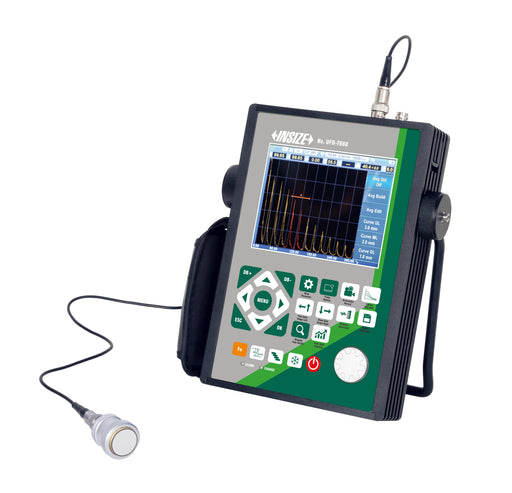
UFD-T680
Ultrasonic Inspection Thickness Gauge
From Original price €0,00
Original price
€0,00
€2.833,00€3.512,92
without VAT
From €2.833,00€3.512,92
Current price
€2.833,00€3.512,92
5-8 Working days
• The all-aluminum metal shell is strong and durable, and the electromagnetic shielding performance is very good• Tempered glass panel, extremely h...
View full details
5805-GT22
Glass Thickness Caliper (Double Glass, Triplex etc.)
From Original price €0,00
Original price
€0,00
€1.300,00€1.612,00
without VAT
From €1.300,00€1.612,00
Current price
€1.300,00€1.612,00
5-8 Working days
Laser reflection principle for measuring the thickness of the glass and the internal air layer. Especially suitable for the manufacture of multi...
View full details
UFD-F720
Digital ultrasonic flaw detector UFD-F720 0-15000mm
From Original price €0,00
Original price
€0,00
€10.822,00€13.419,28
without VAT
From €10.822,00€13.419,28
Current price
€10.822,00€13.419,28
Upon request
Specifications Model/Code: UFD-F720 Measuring range: 0~15000mm Working frequency: 0.4~20MHz Material velocity: 0~10000m/s Dynamic range:...
View full detailsUltrasonic thickness gauges are non-destructive testing (NDT) instruments that measure wall thickness from one side, using ultrasonic pulses reflected from the back wall. They are used for metal thickness measurement on pipes, tanks, ship hulls and steel structures to assess corrosion, wear and remaining thickness — without cutting or dismantling anything.
This collection covers basic digital ultrasonic thickness gauges (Insize ISU-100D, ISU-200D, ISU-250C) for steel, aluminium, cast iron, plastics, glass and ceramics; through-coating models that ignore paint and measure only the metal (ISU-300D, ISU-800D, PCE-TG 300-P5EE); A-scan / B-scan instruments for thin or very thick workpieces (ISU-700D, ISU-710D, ISU-720D, ISU-810D, EMU-A100/B100); and the electromagnetic EMU-S340, which measures through up to 4 mm of rust. It also includes ultrasonic flaw detectors (UFD-T680, UFD-F720) and a glass thickness gauge for double glazing and laminated glass (5805-GT22). We are the official Insize representative in Greece and also stock PCE Instruments.
How to choose
- Painted surfaces — to measure the metal under paint or coating without grinding it off, choose a model with Echo-Echo (through-coating) mode.
- Range & thin material — standard models measure roughly 0.8–300 mm in steel; for sheet below 1 mm there are high-frequency probes (e.g. ISU-700D, 15 MHz).
- Small-diameter pipe — check the probe's minimum pipe size (e.g. Ø20 × 1.2 mm on the ISU-100D).
- A-scan / B-scan — the waveform confirms the reading is the true back-wall echo and not a flaw or a double reflection; useful for inspections and internally corroded material.
- Data logging — reading memory, alarm limits and USB output for inspection reports.
FAQ
How does an ultrasonic thickness gauge work? The probe sends an ultrasonic pulse into the material and times the echo returning from the back wall. With the speed of sound in that material known, the gauge calculates thickness — which is why calibrating on a known thickness or setting the correct material velocity matters.
Do I need couplant gel? Yes, conventional probes need a couplant between the probe and the surface. Gel, replacement probes and calibration blocks are in Ultrasonic Thickness Gauge Accessories.
Can it measure through paint? Only through-coating (Echo-Echo) models can. A standard ultrasonic gauge adds the paint thickness to the reading.
For more, read our guide to ultrasonic thickness gauges.


Manufacturers

