
Thermocouples
The most widely used temperature sensor in industry
What is a thermocouple?
A thermocouple is a simple temperature sensor. In essence it is two wires made of different metals, joined at one end. When that junction heats up or cools down, the thermocouple produces a very small electrical voltage. The greater the temperature difference, the greater the voltage. By measuring this voltage, we determine the temperature.
The basic idea in simple terms
Imagine a metal rod with one end hot and the other cold. At the hot end, the tiny particles inside the metal (the electrons) jiggle more intensely and tend to drift toward the cold end. This small movement creates a microscopic electrical ‘pressure’ — a voltage — from one end to the other. This happens in every metal that has a hot and a cold side.
The heart of the effect
The Seebeck effect
The appearance of a voltage when a metal has a temperature difference between its two ends is called the Seebeck effect. It is the ‘heart’ of how a thermocouple works. Every metal exhibits it to a different degree — some produce a larger voltage, some smaller, for the same temperature difference.
Why are TWO different metals needed?
You might reasonably expect that a single wire would be enough. But a single wire does not work: to measure the voltage we have to connect an instrument, and then the voltage created in one leg is cancelled by the same voltage in the other — the result is zero.
The solution is to use two different metals. Because each metal produces a different voltage for the same temperature, the two voltages do not cancel out completely. What remains is a clean, measurable voltage. That is why every thermocouple is always a pair of two different metals.

Hot junction and cold junction
In a thermocouple there are two points that matter:
Hot junction
The measuring point — where the two metals are joined. We place it where we want to measure, e.g. inside a furnace.
Cold junction
The reference point — where the wires connect to the measuring instrument, at a known temperature.
The two metals are joined to each other only at the hot junction (one point). The thermocouple actually measures the difference in temperature between the hot and the cold junction. That is why the reference temperature must be known, so the instrument can output the correct value.

How voltage becomes temperature
The thermocouple gives a voltage (in millivolts). The measuring instrument reads this voltage and, based on known tables for the specific pair of metals, automatically converts it into the degrees of temperature shown on the display. Each thermocouple type has its own conversion table.
Reference temperature and cold junction compensation
As we saw, the thermocouple actually measures the difference in temperature between the hot and the cold junction — so the instrument must continuously know the temperature of the cold junction (the point where the wires terminate at the terminals). This continuous measurement and correction is called cold junction compensation and requires a second, accurate sensor placed on the terminals. This is where the thermistor comes in: a small semiconductor component whose electrical resistance changes strongly and in a known, predictable way with temperature (usually NTC type — the resistance drops as the temperature rises). The instrument measures the thermistor’s resistance, calculates the temperature of the terminals and ‘adds’ it to the thermocouple’s signal, so that the final reading corresponds to the real temperature of the hot junction. We choose a thermistor for this job because, precisely in the range of ambient temperature — that is, where the terminals are located — it offers very high sensitivity and resolution (a much larger change per degree than a thermocouple or even a Pt100), while at the same time being cheap, small, with fast response and sufficient accuracy in this narrow range — exactly what is needed for the instrument to ‘know’ its reference temperature.
(Source: Kerlin & Johnson, ‘Practical Thermocouple Thermometry’ (ISA, 2012), cold junction compensation; ASTM, ‘Manual on the Use of Thermocouples in Temperature Measurement’ (MNL 12), reference junction section.)
Thermocouple types
In theory any two different metals make a thermocouple. In practice, though, only a few standardized types are used, each with a letter (K, J, etc.). The table gives a quick comparison; below you will find a detailed description for each type. The colour dot follows the IEC 60584 code.
| Type | Metals | Range | Best for |
|---|---|---|---|
| K | Nickel-Chromium (Chromel) / Nickel-Aluminum (Alumel) | −200…1260 °C | General use, oxidizing atmospheres |
| J | Iron / Constantan (Copper-Nickel) | 0…760 °C | Economical, reducing atmospheres |
| T | Copper / Constantan (Copper-Nickel) | −200…370 °C | Low / cryogenic, humidity |
| E | Nickel-Chromium (Chromel) / Constantan (Copper-Nickel) | −200…900 °C | Maximum sensitivity (largest signal) |
| N | Nicrosil (Ni-Cr-Si) / Nisil (Ni-Si) | −200…1300 °C | High temperatures, more stable than K |
| S | Platinum-10% Rhodium / Platinum | 0…1480 °C | High accuracy, reference standard |
| R | Platinum-13% Rhodium / Platinum | 0…1480 °C | High accuracy at very high temps |
| B | Platinum-30% Rhodium / Platinum-6% Rhodium | 870…1700 °C | The highest temperatures |
The ranges are those recommended for sheathed thermocouples and depend on the wire diameter and the atmosphere. (Source: ASTM, ‘The Use of Thermocouples in Temperature Measurement’, Ch. 3.)
The colour code follows IEC 60584-3 (positive-conductor colour; the negative is always white). Types R and S share the same orange in the standard — here they are slightly differentiated for clarity; type B has no established colour (grey by convention).
In detail, by type
Tap a type to see more details.
KType K — the most common, general purpose›
The most widely used general-purpose type: cheap, durable and with a relatively high, almost linear signal (~41 µV/°C). It offers the best combination of cost and performance in oxidizing or inert atmospheres. Watch out for two things: in reducing or oxygen-poor atmospheres it is at risk of ‘green-rot’ corrosion (roughly 800–1050 °C), while around 250–550 °C it shows a small reversible drift of a few degrees (the ‘K-state’ effect). First choice when there is no special requirement.
JType J — economical, high signal›
Economical and with a high signal (~50–55 µV/°C), i.e. good sensitivity. It works in oxidizing, reducing and inert atmospheres, even in vacuum — versatile for industrial use up to ~760 °C. Its weak point is the iron leg: it oxidizes quickly above ~540 °C and rusts in humidity. That is why it is not recommended below 0 °C nor for long-term use near its upper limit.
TType T — low temperatures and humidity›
The best choice for low and cryogenic temperatures, humidity and wet environments, since copper resists corrosion. It has excellent accuracy and repeatability in its range and can operate in oxidizing, reducing, inert or vacuum atmospheres. The upper limit of ~370 °C is because above that copper oxidizes quickly; note also that copper’s high thermal conductivity can ‘draw’ heat away from the measuring point in thin setups.
EType E — maximum sensitivity›
It gives the largest signal (~68 µV/°C) of all the common types, hence the maximum sensitivity and resolution — ideal when you want to detect very small temperature changes. Both legs are non-magnetic, which helps stability. It performs excellently in oxidizing and inert atmospheres as well as at low temperatures; avoid it in reducing or oxygen-poor atmospheres, where the Chromel leg suffers ‘green-rot’.
NType N — improved K for high temperatures›
Designed as an improved version of K: the addition of silicon (Si) forms a protective oxide layer that gives it greater long-term stability, less drift around 1000 °C and increased resistance to both ‘green-rot’ and the ‘K-state’ effect. Choose it for high temperatures when you need greater stability and lifetime than K, at a similar cost (base metals).
SType S — noble metal, reference standard›
A noble-metal thermocouple (platinum) with top accuracy and stability at high temperatures, in oxidizing or inert atmospheres — so reliable that it is also used as a temperature reference standard. Its signal, however, is very low (~10 µV/°C), so it requires a high-resolution instrument. It is sensitive to contamination from metal vapours, hydrogen and reducing atmospheres, which is why it needs ceramic protection. Expensive — you choose it when accuracy at high temperatures is paramount.
RType R — like S, for very high temperatures›
Very close to S (also platinum), with a slightly higher signal and somewhat better behaviour at very high temperatures, thanks to its higher rhodium content. It has the same requirements as S: an oxidizing or inert atmosphere, ceramic protection from contamination and a high-resolution instrument for the low signal. High accuracy and correspondingly high cost.
BType B — for the highest temperatures›
Made for the highest temperatures. Both legs contain rhodium, which gives it greater stability and less drift than R/S at the ends of the range. Its peculiarity: the signal is almost zero below ~50 °C, so cold junction compensation is often not even needed — but for the same reason it is completely unsuitable for low temperatures. A choice for furnaces and processes above ~1500 °C.
What to choose — a quick guide
Not sure / general use in oxidation: type K.
Low / sub-zero temperatures or humidity: type T.
You need high sensitivity: type E.
High temperatures with more stability than K: type N.
Very high temperatures / maximum accuracy: platinum S / R / B (expensive).


← All guides

Related guides
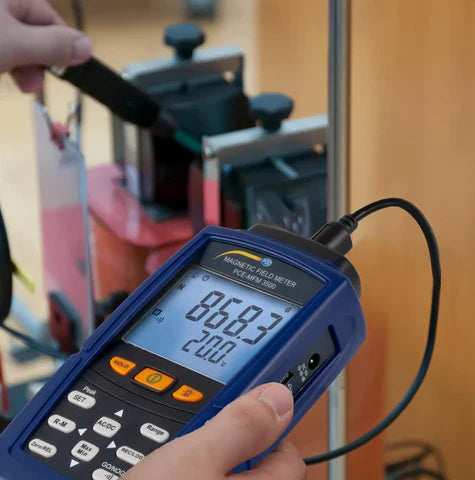
EMF MetersMeasuring electromagnetic radiation and fields (EMF).
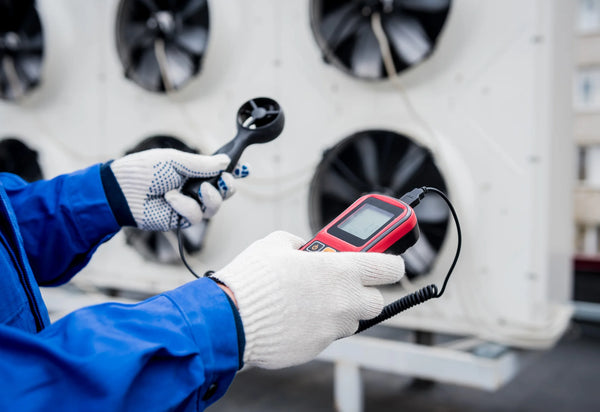
AnemometersMeasuring air speed and flow: thermal and vane types.
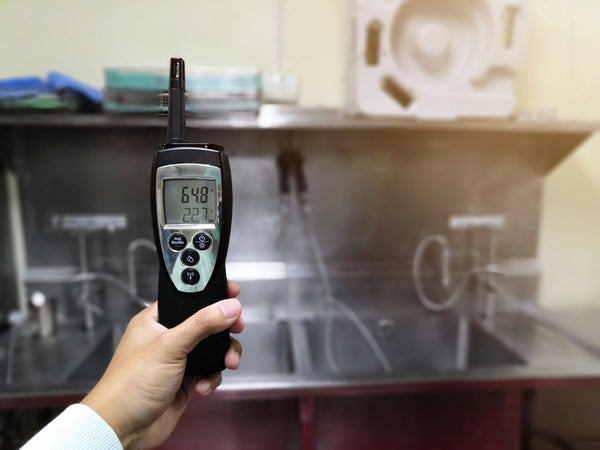
Hygrometers & Room ThermometersMonitoring room temperature and relative humidity.
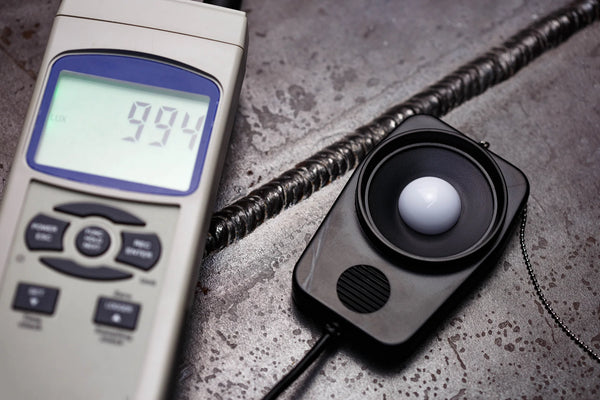
Light MetersMeasuring illuminance (lux) in workspaces.
Infrared ThermometersNon-contact temperature measurement with infrared.
Contact ThermometersAccurate temperature measurement with contact sensors.
Dust MetersMeasuring airborne particles and air quality.
Sound Level MetersMeasuring noise level (dB) to standards.