
Gas Detectors - Dust Meters
4 από 4 products
Data Out
Software
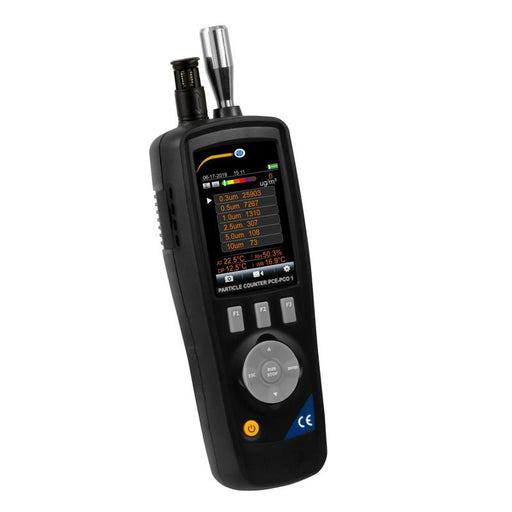

PCE-PCO 1
Dust Meter - Air Quality - PM0.3 / PM0.5 / PM1 / PM 2.5 / PM5 / PM 10 - Datalogger - SD Card

Translation missing: en.product_price.item.price.range_html
Original price
€0,00
€1.055,00€1.308,20
without VAT
From €1.055,00€1.308,20
Current price
€1.055,00€1.308,20
Available
General Features Environmental conditions 0 ... +50 °C / +32 ... +122 °F, 10 ... 90 % RH (non-condensing) Display Color, backlit 2.8" LCD...
View full details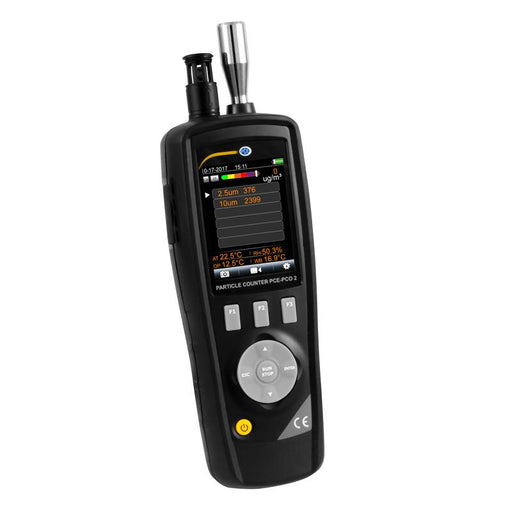
PCE-PCO 2
Dust Meter - Air Quality - PM0.3 / PM0.5 / PM1 / PM 2.5 / PM5 / PM 10 - Datalogger - SD Card - Built-in Camera

Translation missing: en.product_price.item.price.range_html
Original price
€0,00
€1.341,00€1.662,84
without VAT
From €1.341,00€1.662,84
Current price
€1.341,00€1.662,84
Available
Particle specifications Particle channels PM 2.5 / PM 10 Particle concentrations 0 ... 2000 μg / m³ Reading 1 μg / m³ Particle...
View full details
PCE-PQC 30EU
Dust Meter 0.3-25μm - Factory calibrated at 0.3, 0.5, 1.0, 2.5, 5.0, 10.0 μm variable binning
Translation missing: en.product_price.item.price.range_html
Original price
€0,00
€6.038,00€7.487,12
without VAT
From €6.038,00€7.487,12
Current price
€6.038,00€7.487,12
By order
Measuring range 0.3 ... 25 μm Channel size measurement Factory calibrated at 0.3, 0.5, 1.0, 3.0, 5.0, 10.0 μm Measurement efficiency 50% a...
View full details

0811-CA01
Dust Meter - Air Quality
Translation missing: en.product_price.item.price.range_html
Original price
€0,00
€3.141,00€3.894,84
without VAT
From €3.141,00€3.894,84
Current price
€3.141,00€3.894,84
By order
Technical Specifications Sampling flow rate: 2.83L/min (0.1ft³), accuracy ±5% Particle diameters: 0.3μm, 0.5μm, 1μm, 3μm, 5μm, 10μm (simultaneo...
View full detailsGas detectors - dust meters are portable or fixed instruments used to detect hazardous gases early and to measure airborne dust/particle concentration. They support leak checks, indoor air quality assessments and worker protection in industrial environments.
Options include single- and multi-gas units for O2, CO, H2S and combustible gases, with audible/visual alarms, data logging and calibration support. You will also find dust meters for PM monitoring with selectable sampling modes and filters, from PCE Instruments & Insize.
Suitable for HSE teams, maintenance, chemical plants and construction sites; choose based on target gas/PM type, measuring range and compliance requirements.

Manufacturers

