
Height Gauges
A high precision instrument for measuring height and for marking out, checking flatness and parallelism on a surface plate.
A height gauge, also called a height scriber, is a high precision instrument for measuring vertical dimensions. It also serves as a marking out tool and, combined with a dial test indicator, as a means of checking flatness and parallelism. It is normally used on a surface plate (granite plate), which provides the flat reference surface across which the gauge slides freely.

Parts of the height gauge
A height gauge is made up of a few basic parts that determine its accuracy.

1Base
2Beam (main scale)
3Fine adjustment
4Vernier
5Vernier clamp screw
6Scriber
1
Base: the foot that rests on the surface plate and defines the reference plane. It is heavy and rigid so the gauge stands steady and works as a reliable datum.
2
Beam or column: the vertical rail that carries the graduated scale, along which the carriage of the instrument slides.
3
Fine adjustment: lets you move the carriage by very small amounts through a fine feed screw, for precise setting.
4
Vernier: the auxiliary scale that resolves the decimals of the reading. The vernier line that coincides with a line of the main scale gives the exact value, reading down to 0.02 mm.
5
Vernier clamp screw: locks the carriage to the beam so the reading does not shift while you take it or scribe a line.
6
Scriber: the measuring and marking tip, usually carbide tipped for wear resistance, that locates the top land of the workpiece.
Types and accessories
Depending on how they are read, height gauges are vernier, dial or digital. Digital gauges carry a processor and perform automatic calculations, such as the centre and diameter of holes, centre to centre distances and the maximum or minimum value over a scan, while compensating automatically for the probe diameter. The vernier is read in the same way as on a caliper.
The measuring tip changes to suit the job.
Scriber: the basic accessory. It covers most features, locates top lands and scribes straight lines.
Test indicator: replaces the scriber when more sensitivity is needed, for example when checking the parallelism of a surface.
Depth bar: works like a depth micrometer and measures surfaces that sit lower than the base of the instrument.
Ball probe: measures the centre of a hole and centre to centre distances, and can be inverted to reach higher features.
The surface plate as a reference surface
The accuracy of a height gauge depends directly on the flatness of the surface plate. The plate defines the reference plane from which every height measurement starts, so any flatness error of the plate is carried straight into the reading. Today granite is the most common material for surface plates in the laboratory, in inspection and on the shop floor, while older cast iron plates are gradually being retired.
Granite has several practical advantages. It does not rust and, if it is knocked, it does not raise a burr that would lift the instrument; instead it forms a small hollow. It also takes in and releases heat slowly, so it is less sensitive to local thermal changes. It does have one weakness, moisture can deform it. In a controlled test, granite plates that were wetted with water needed about ten days to return to their original flatness, which is why we avoid lapping with a wet solvent and an immediate flatness check straight afterwards.
| Property | Cast iron | Granite |
|---|---|---|
| Rust | Rusts | Does not rust, but can be deformed by moisture |
| Burr on impact | Raises material upward | Forms a hollow, does not raise material |
| Thermal behaviour | Takes in and releases heat quickly | Takes in and releases heat slowly |
| Cost | Relatively expensive | Relatively economical |
Possible sources of error
As with calipers, sources of error include:
Abbe principle
Why the gauge is sensitive to tilt
The Abbe principle states that the measuring scale should lie in line with the dimension being measured. On a height gauge the scriber stands away from the reading column, so the principle is not met. Any small tilt of the carriage or bending of the column turns into a measurement error, which grows as the scriber moves further from the column, that is, as the dimension "h" increases.
Error from the parallax effect.
Error from excessive force, because the height gauge does not obey the Abbe principle.
Error from thermal expansion, due to a temperature difference between the gauge and the workpiece.
Error from bending of the main beam that guides the scriber. This error is found as follows. As the illustration shows, fitting a scriber or a centring indicator needs particular care, because the dimension "h" grows and leads to a larger error.

Example
When the dimension "h" is 150 mm, the error is 1.5 times larger than when it is 100 mm.

When setting with the help of gauge blocks, if too much force is applied the base can lift and stop sitting perfectly on the surface plate, which introduces an error. For accurate measurements the scriber tip should just barely touch the block. The surface of the plate and the base of the height gauge must also be cleaned very carefully of dust.

Using the height gauge
Keep the main sliding beam clean of dust and dirt.
Parallelism between the gauge and the surface plate should be at least 0.01 mm.
Parallax, as on a plain vernier, can cause a significant error. Always read a measurement looking straight on.
After use: always clean off any water and oil.
Storage: avoid sun exposure, high and low temperatures and high humidity during storage. Protect it from dust by covering the gauge or keeping it in its case.


← All guides

Related guides
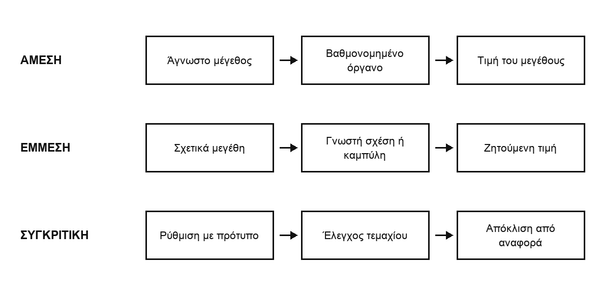
Direct, indirect and comparative measurementΟι διαφορές ανάμεσα στην άμεση, την έμμεση και τη συγκριτική μέτρηση, με παραδείγματα από διαστάσεις, ζύγιση και περιβάλλον.
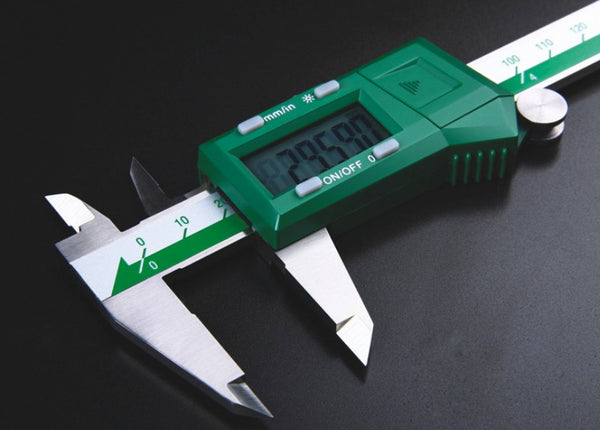
CalipersTypes, accuracy and how to choose the right caliper.
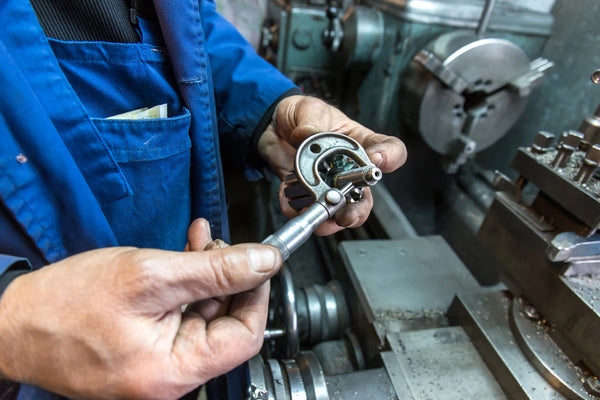
MicrometersΕξωτερικά, εσωτερικά και βάθους: εύρη, ανάλυση και επιλογή.
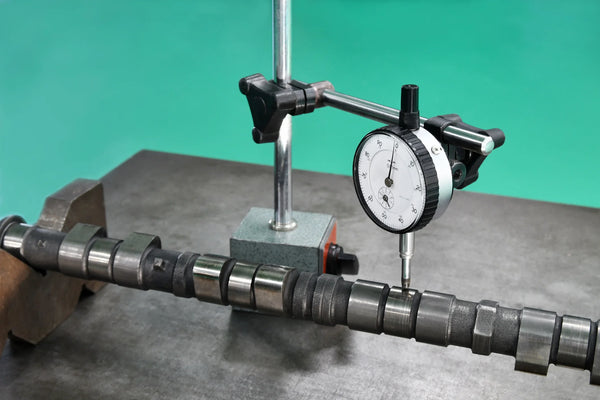
Dial IndicatorsΑναλογικά και ψηφιακά ρολόγια συγκριτικά με τη σωστή βάση.
Measuring TapesAccuracy classes, materials and choosing for each use.
Steel RulesSteel rules and precision scales for lab and workshop.
Bore Measurement InstrumentsAccurate internal bore measurement: types and methods.
Magnetic BasesSturdy indicator holding stands with magnetic locking.
CalibrationsΤι αποδεικνύει ένα πιστοποιητικό, πώς εξασφαλίζεται η μετρολογική ιχνηλασιμότητα και πότε απαιτείται διαπιστευμένο εργαστήριο.