
Vickers Hardness Measurement Method
Vickers Hardness Measurement Method

The Vickers method is a static hardness testing method, which has the following characteristics:·
- It is a hardness measurement method specified by ISO 6507, ASTM E92, ASTM E384 standards.
- The Vickers method has a test load range from 1 gf to 120 kgf according to ASTM, which means that this method can be used for hardness tests across all load scales
- It is an optical method. This means that the size of the indentation left by the indenter on the specimen is measured to determine the hardness value.
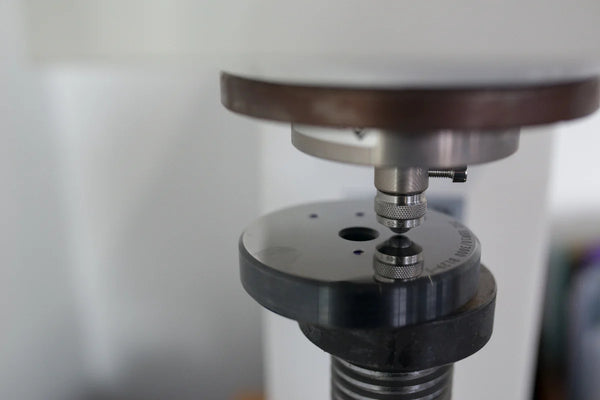
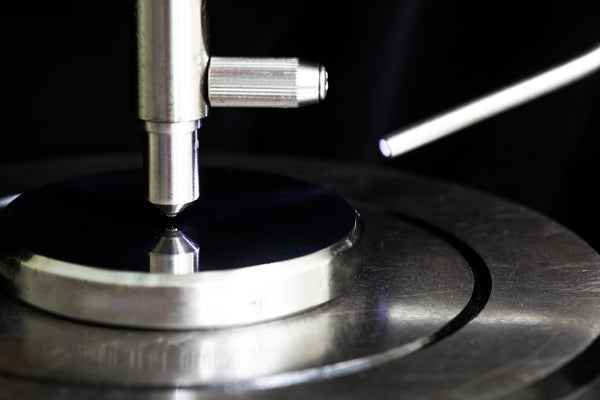
- Indenter shape and material: The indenter is a diamond equilateral pyramid (with a square base) with an included angle of 136°.
TABLE 1
| Load range | Method | Indenter | Test force F | Applications | |
|---|---|---|---|---|---|
| Micro hardness range | HV0.01 | Diamond pyramid 136ο | 0.098Ν | Structural components, very thin layers | Range 1HV- 3000HV |
| HV0.025 | 0.245Ν | ||||
| HV0.05 | 0.490Ν | ||||
| HV0.1 | 0.980Ν | ||||
| Low-force range | HV0.2 | Diamond pyramid 136ο | 1.961Ν | Thin layers CHD/SHD/NHD, thin metal sheets, small specimens | |
| HV0.3 | 2.942Ν | ||||
| HV0.5 | 4.903Ν | ||||
| HV1 | 9.807Ν | ||||
| HV2 | 19.61Ν | ||||
| HV3 | 29.42Ν | ||||
| Macro range (common hardness range) | HV5 | Diamond pyramid 136ο | 49.03Ν | Standard specimens | |
| HV10 | 98.07Ν | ||||
| HV20 | 196.1Ν | ||||
| HV30 | 294.2Ν | ||||
| HV50 | 490.3Ν | ||||
| HV100 | 980.7Ν |
Operating principle
Vickers hardness (HV) is obtained from the quotient of the applied test force (F in newton N) and the surface area of the indentation on the sample (Figure 1). To calculate the indentation surface area, the average of the two diagonals (d1 and d2 in mm) is used, because the base area of Vickers indentations is often not exactly square. Ideally, the test force is increased from 0 to the final value within 7 seconds (minimizing measurement uncertainty). The maximum permissible interval for the application time according to the standard is 2 to 8 seconds (nominal duration 7 seconds). In general, the dwell time for the test force is 10 to 15 seconds (nominal duration 14 seconds).

Figure 1: Operating principle of Vicker hardness measurement.
Sample requirements for the Vickers method
When the Vickers hardness testing method is used, it is usually necessary to prepare the surface of the sample to be tested, as the sample surface quality requirements are significantly stricter than those of the Rockwell method, where it is sufficient for the surface to be free of dust and impurities.
:::info
Abbreviation explanation
1. The numerical hardness value (between 1 and 3000).
2. The two letters "HV" indicate the Hardness Vickers method.
3. The applied test load in kgf. (Table 1).


← All guides

Related guides

Μη Καταστροφικός ΈλεγχοςΣκληρότητα ΜετάλλωνOverview of hardness testing methods and choosing an instrument.
Μη Καταστροφικός ΈλεγχοςΜεθοδος Μέτρησης Σκληρότητας BrinellThe Brinell method — principle, applications and the HB scale.
Μη Καταστροφικός ΈλεγχοςRockwell C Κλίμακα ΣκληρότηταςThe Rockwell C scale (HRC) for hard metals.
Μη Καταστροφικός ΈλεγχοςShore Durometer Κλίμακα ΣκληρότηταςMeasuring the hardness of rubber and plastics on the Shore scale.
Μη Καταστροφικός ΈλεγχοςΠαχύμετρα ΕπικαλύψεωςMeasuring paint and coating thickness on metal.
Μη Καταστροφικός ΈλεγχοςΠαχύμετρα ΥπερήχωνMeasuring material thickness with ultrasound from one side.
Μη Καταστροφικός ΈλεγχοςΜετρητές ΔόνησηςChecking machine vibration for preventive maintenance.
Μη Καταστροφικός ΈλεγχοςΤραχυμέτραMeasuring surface roughness (Ra, Rz) to standards.