
Skip to content
2102231624 - Δωρεάν μεταφορικά άνω 50€ - Τιμές χωρίς ΦΠΑ

Electromagnetic Radiation EMF Meters

  • PCE Instruments
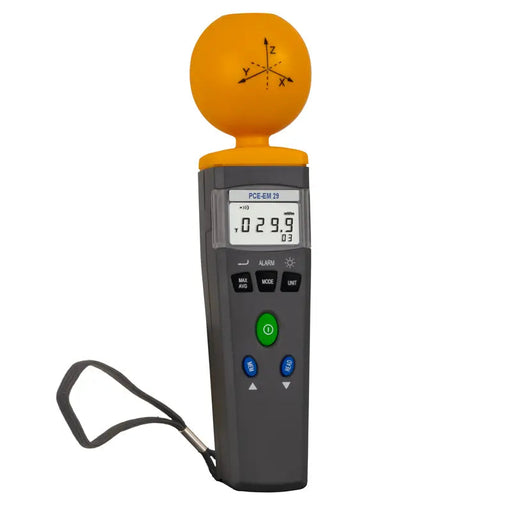
    PCE-EM 29

    Radio Frequency (RF) Meter for Wi-Fi & 5G Tri-Axis

    Original price €319,00 - Original price €319,00
    Original price
    €319,00
    €319,00 - €319,00
    Current price €319,00

    Frequency range 50 MHz ... 3.5 GHz Sensor type Electric field (E) Measurement three-dimensional, isotropic Measurement range 20 mV/m ......

    View full details
    Διαθέσιμο
  • PCE Instruments
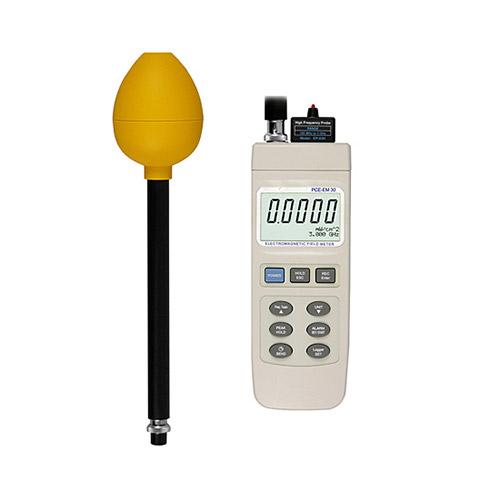
    PCE-EM 30

    Professional Radio Frequency (RF) Tri-Axis Meter

    Original price €2.094,00 - Original price €2.094,00
    Original price
    €2.094,00
    €2.094,00 - €2.094,00
    Current price €2.094,00

    Bandwidth / Frequency range of the EP-03H sensor 100 MHz ... 3 GHz Range options for the EP-03H detector 900 MHz, 1 GHz, 1.8 GHz,2.4 GHz,...

    View full details
    5-8 Εργάσιμες
    USB

Frequently Asked Questions (FAQ) 


1. Where should I start? How to choose a meter?


The most important first step is to identify the source of the electromagnetic fields that concern you. We primarily categorize our meters based on the type of field they measure:

  • Low Frequencies (ELF): For fields from power transmission cables, electrical installations, and most household appliances.

  • High Frequencies (RF): For fields from wireless technologies such as Wi-Fi, mobile phones, and mobile phone antennas.

Once you know the source, you can choose a meter from the correct category.


2. What is the real difference between Low (ELF) and High (RF) Frequencies?


Think of it this way:

  • Low Frequency (ELF) fields are created by the electricity that powers our homes and cities (at 50 Hz in Greece and Europe). Sources include anything plugged into the socket or related to the electrical grid.

  • High Frequency (RF) fields are used for communication. They carry information through the air. Sources include any wireless device that transmits or receives data.

These two types of fields have different characteristics and require different instruments to be measured accurately.


3. I am concerned about the power company cables, transformers, or the electrical installation in my home. Which meter is suitable?


For these sources, you need a Low Frequency (ELF) Meter. These meters are designed to measure the magnetic and/or electric fields of your electrical system.

  • Look in the category Low Frequency (ELF) Meters.

  • If you only need to measure magnetic fields (the most common concern for ELF), a Magnetic Field Meter (Gaussmeter) is the right choice.


4. I want to measure radiation from the Wi-Fi router, my mobile phone, or a nearby mobile phone antenna. Which meter do I need?


For all wireless sources, you need a High Frequency (RF) Meter. These instruments are specially designed to detect the fields used for wireless communication.

  • Look in the category High Frequency (RF) Meters.

  • Most users will find a Broadband RF Meter suitable, as it measures the total RF radiation in an area.


5. What does "Single-Axis" and "Tri-Axis" mean? Which is better?


This refers to the meter's sensor.

  • A Single-Axis meter measures the field in only one direction at a time. It is like a flashlight—you have to point it in different directions to find the highest value. They are often more economical.

  • A Tri-Axis meter has three sensors and measures the field simultaneously in all directions. It automatically gives you the total field strength, making measurements much faster and easier.

For ease of use and more accurate results, a Tri-Axis meter is generally better and recommended for most users.


6. Why is there such a big price difference? (Home vs Professional Use)


The price difference usually depends on three things: accuracy, features, and frequency range.

  • Meters for Home/Personal Use are excellent for identifying main sources of EM fields and for a reliable general assessment. They are user-friendly and economical.

  • Professional meters offer higher accuracy, wider frequency range, and advanced features such as data logging for detailed analysis and reporting.


7. I need to measure static fields from magnets or a photovoltaic system. What about those?


These sources produce DC magnetic fields (direct current). A conventional ELF meter for AC fields (alternating current) will not detect them. You need a meter that explicitly states it can measure DC magnetic fields.

  • Look for a DC Magnetic Field Meter (DC Gaussmeter) or a combined meter with settings for AC/DC magnetic fields.


8. Should I just get a combined meter that measures everything?


A Combined Meter (ELF & RF) can be an excellent and cost-effective choice if you want to assess your overall electromagnetic environment. It allows you to check both fields from wiring as well as from wireless devices with a single instrument. It is an ideal "all-in-one" solution for home users.