
Tachometers
5 από 5 products
Data Out
Software
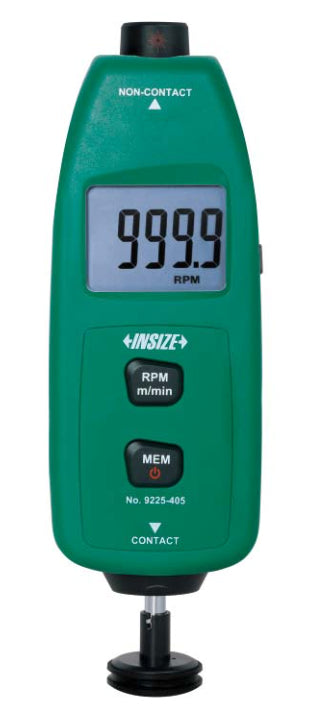

9225-405
Digital Tachometer - Laser & Contact, Economy
Translation missing: en.product_price.item.price.range_html
Original price
€0,00
€87,00€107,88
without VAT
From €87,00€107,88
Current price
€87,00€107,88
Available
2 measurement methods: contact and non-contact Can measure rotational speed and linear speed Automatic storage of the maximum value, minimum value...
View full details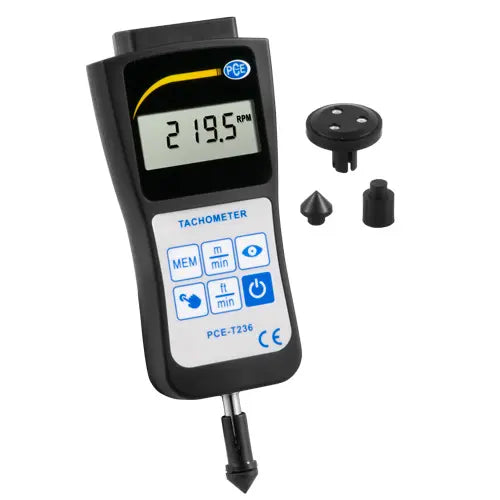

PCE-T236
Digital Tachometer - Laser and Contact
Translation missing: en.product_price.item.price.range_html
Original price
€0,00
€186,00€230,64
without VAT
From €186,00€230,64
Current price
€186,00€230,64
Available
Laser measurement range 5 ... 99999 rpm Contact measurement range 0.5 ... 19999 rpm, 0.05 ... 1999 rpm, 0.2 ... 6560 ft/min Reading (...
View full details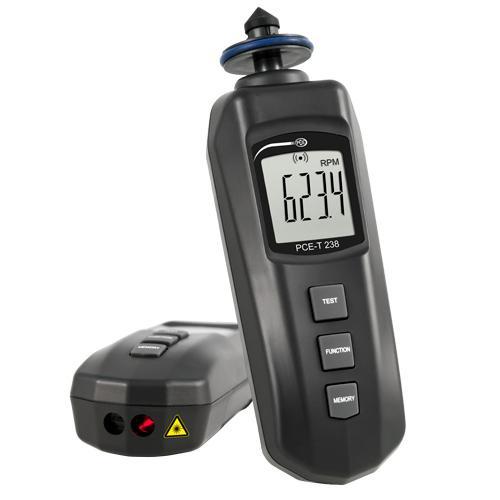
PCE-T 238
Digital Tachometer - Laser and Contact


Translation missing: en.product_price.item.price.range_html
Original price
€0,00
€270,00€334,80
without VAT
From €270,00€334,80
Current price
€270,00€334,80
Available
Measurement range for laser 5 ... 99,999 rpm Measurement range for non-contact measurement 0.5 ... 19,999 rpm Measurement range for surfac...
View full details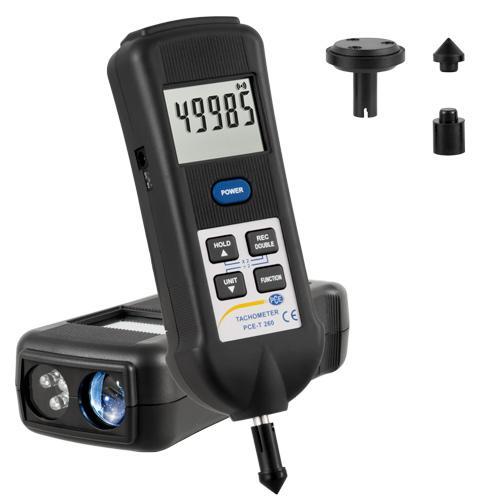
PCE-T 260
Digital Tachometer - Stroboscope - Laser and Contact - Temperature Measurement Capability
Translation missing: en.product_price.item.price.range_html
Original price
€0,00
€468,00€580,32
without VAT
From €468,00€580,32
Current price
€468,00€580,32
5-8 Working days
Laser tachometer measurement Measuring range 5 ... 99999 rpm Reading 0.5 U/min (1000 rpm) Accuracy ±0.05% + 1 Digit Distance fro...
View full details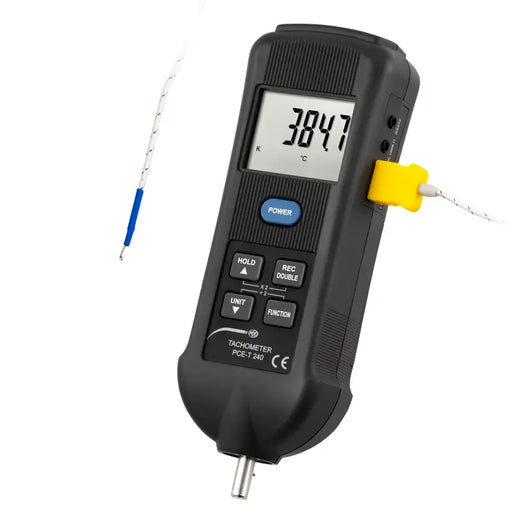
PCE-T 240
Digital Tachometer - Laser and Contact with ±0.05% Accuracy - Thermometer
Translation missing: en.product_price.item.price.range_html
Original price
€0,00
€338,00€419,12
without VAT
From €338,00€419,12
Current price
€338,00€419,12
5-8 Working days
Laser measurement Measuring range 5 … 99,999 rpm Reading 0.5 RPM ( 1 RPM (≥1,000 RPM) Accuracy ±(0.05% of reading + 1 digit) Det...
View full detailsTachometers are measurement instruments used to verify rotational speed (RPM) on shafts, motors, pulleys and belts, and—using contact wheels—measure linear speed and total length. They support setup, maintenance and troubleshooting of rotating equipment with fast, repeatable readings.
This collection includes non-contact laser models, contact tachometers, and combo units, with different ranges, resolution and response time, plus options for m/min or m/s measurements. Choose solutions from Insize, PCE Instruments & Ultra, with ergonomic housings and accessories for reliable contact measurements.
Common in industrial maintenance, HVAC, automation and QC; select based on target distance, surface reflectivity and required accuracy.


Manufacturers

