
Dial Indicators
An analog comparison gage that measures small displacements and deviations, amplifying the travel of the spindle through a gear train.

What a dial indicator is
A dial indicator, also called a dial gauge, is an analog comparison gage used in engineering for high precision measurement of small displacements. While a micrometer gives the overall dimension of a part, a dial indicator shows the deviation of the actual size from its nominal value, amplifying that deviation so it becomes easy to read.
The hand movement is driven by a rack-and-pinion and a train of gears, which is what magnifies the small motion of the spindle. Dial indicators are available in analog and digital forms. Lever type test indicators are used for centering machine tools, checking eccentricity (runout) and checking out of roundness.
A dial indicator reveals lengths that cannot be discerned by eye, for example a small height difference between two flat surfaces, a slight loss of concentricity between two cylinders, or other small physical deviations.
With the appearance of an ordinary clock, dial indicators are also used to measure tolerances on machined parts, to check the flatness of bars and, more generally, for any measurement that involves small deviations.

Technical characteristics
A dial indicator is defined by several technical characteristics:
- Its measuring range, or travel (0-5mm, 0-10mm, 0-30mm and so on)
- Its graduation, or resolution (0.01mm, 0.001mm and so on)
- Its size (the bezel diameter, Ø40mm, Ø58mm and so on)
- The number of revolutions of the main hand per mm of travel
- The revolution counter, a small second hand that counts the revolutions of the main hand
- Whether it is shockproof (a more robust internal mechanism for longer service life)
- Whether it is waterproof, with an IP protection rating
- Balanced dial for comparison measurements (for example a reading of ±0.4mm)


Applications
- Checking the runout of brake discs, typically 0.05mm or less.
- Quality control in production.
- In the machine shop, for calibrating and setting up machines (for example indicating a milling cutter).
- Centering the workpiece in a lathe chuck.
- A wide range of precision applications outside the machine shop, such as geology, physics and so on.
Stem mounting (flat back type)

Notes
- The hole that receives the stem is toleranced Ø8 G7 (±0.005-0.02mm). The AGD standard stem diameter is Ø8mm in metric models (Ø.375 in inch models).
- Take particular care when clamping. Over tightening hampers the motion of the spindle and so introduces a measuring error.
Lug mounting (rear lug)

Notes
- To minimize the cosine error, the spindle should be aligned with the direction of the measurement.
Why orientation matters

When the measurement is taken with the indicator horizontal, or even inverted, the measuring force at the contact point is naturally lower. A dial indicator should in fact not be used upside down, because its preloaded spindle is not strong enough to overcome its own weight. In these positions the repeatability of the measurements must be verified.
Maintenance
- Do not use lubricants (oil) on the moving spindle. Oil tends to collect dust and hampers the motion.
- If the motion is not smooth, clean the spindle with a cloth and alcohol.
- Before taking any measurement, make sure the spindle moves smoothly up and down.
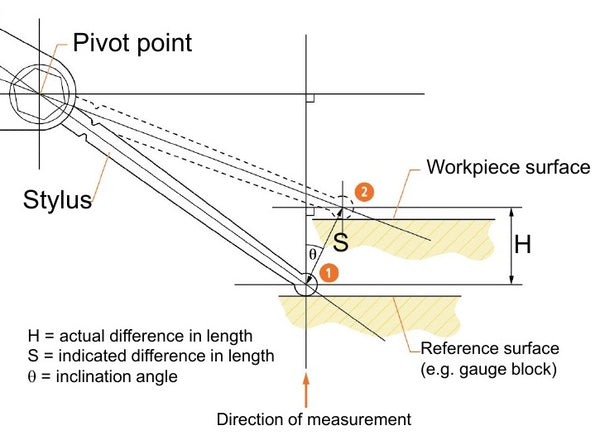
Cosine error (the cosine effect)
The measurement will be in error if the direction of the intended measurement does not coincide with the direction of the spindle. This error is minimized by setting the spindle so that the angle θ is as small as possible, preferably within 15°.


← All guides

Related guides
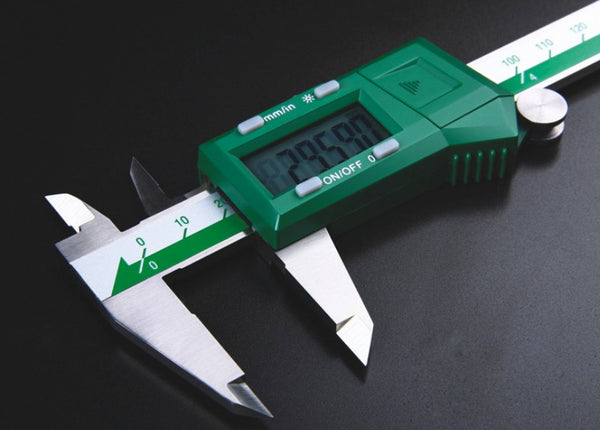
CalipersTypes, accuracy and how to choose the right caliper.
ΜικρόμετραΕξωτερικά, εσωτερικά και βάθους — εύρη, ανάλυση και επιλογή.
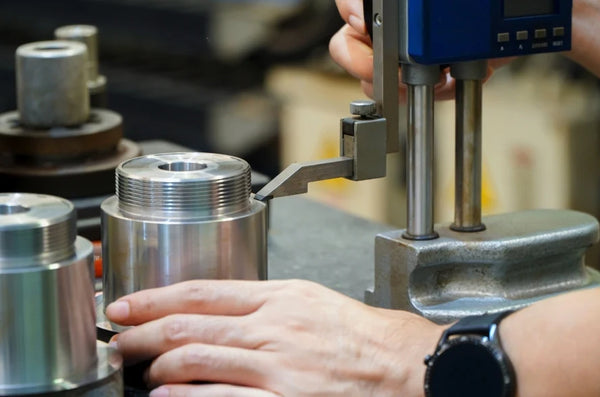
Height GaugesMeasuring and scribing height accurately on the surface plate.
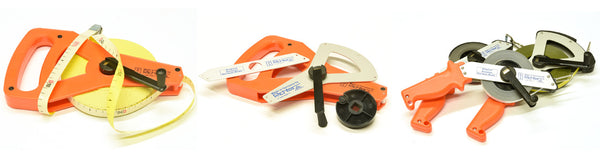
Measuring TapesAccuracy classes, materials and choosing for each use.
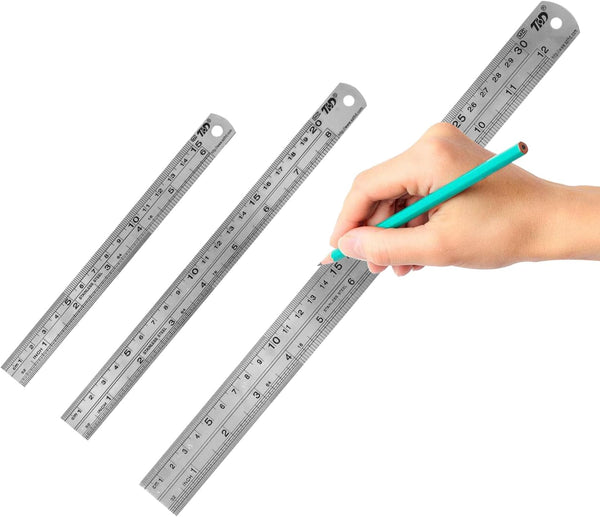
Measurement StripsSteel rules and precision scales for lab and workshop.
Cosine errorΓιατί η λοξή τοποθέτηση του οργάνου αλλοιώνει τη μέτρηση.
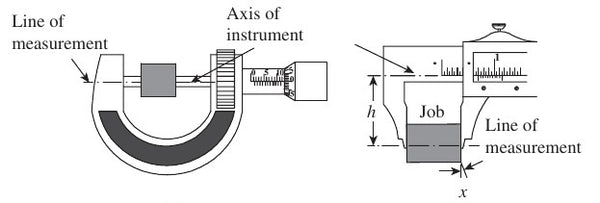
The Abbe principle and Abbe errorΗ αρχή του Abbe ορίζει ότι μέγιστη ακρίβεια επιτυγχάνεται μόνο όταν η κλίμακα μέτρησης (το πρότυπο) βρίσκεται στην ίδια ευθεία με τον άξονα της διάστασης που μετράμε.
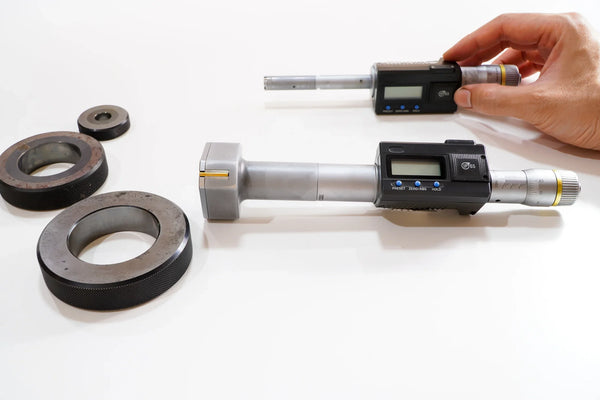
Hole MeasurementAccurate internal bore measurement — types and methods.
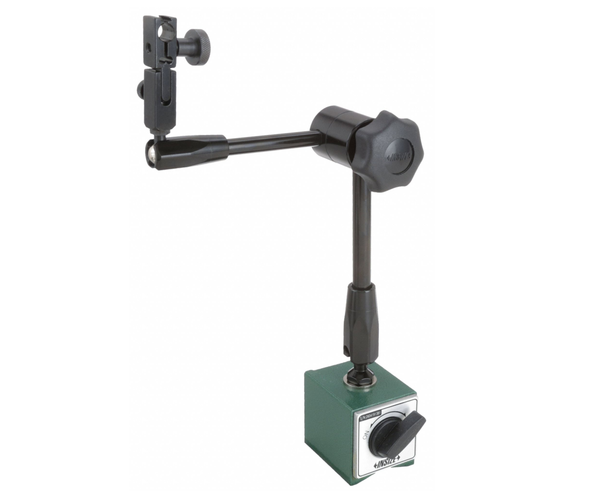
Magnetic basesSturdy indicator holding stands with magnetic locking.
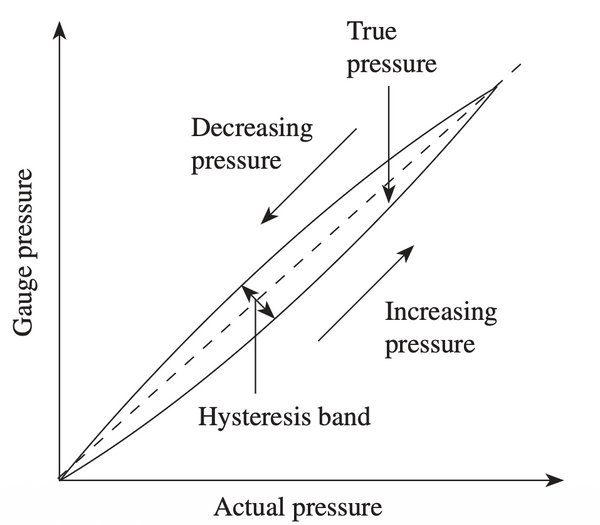
Υστέρηση (Hysteresis)Γιατί η ένδειξη ενός οργάνου αλλάζει ανάλογα με τη φορά της κίνησης.