
[P] - STEELS (STEEL)
Steels are called iron-carbon alloys (Fe-C) up to 1.5%C. Depending on the applications for which they are intended, steels also contain other alloying elements that modify their properties. In machining technology and specifically according to VDI 3323 they are classified into:
P 1-5 - Plain Carbon Steels
(Irons - Black - St37 - ck40)
- Microstructure:
- Fe-C alloys that do not contain other alloying elements.
- Machinability:
- Chips: Continuous and long
- Tool wear: Low to moderate
- Cutting type: High cutting speeds, moderate feed
- Surface quality: Good
- Machinability decreases after hardening.
P 6-9 - Low-Alloy Steels
(Steels - Structural Steels)
- Microstructure:
- Fe-C alloys that contain small amounts of alloying elements (<10%)(Mn,Nb,V,Ti). Although the alloying percentages are small, they exhibit much better properties than plain steels.
- Machinability:
- Chips: Continuous and long
- Tool wear: Moderate
- Cutting type: Moderate cutting speeds, moderate feed
- Surface quality: Good
- Machinability decreases after hardening.
- Cutting fluid is recommended
P 10-11 - Highly Alloyed Steels - Tool Steels
- Microstructure:
- Fe-C alloys that contain large amounts of alloying elements (>10%). They are used mainly for cutting or forming tools in molds.
- Machinability:
- Chips: Continuous, long and hard
- Tool wear: High
- Cutting type: Low cutting speeds, low feed
- Surface quality: Good but requires finishing
- Machinability decreases significantly after hardening.
- High-performance cutting fluid is required
← All guides

Related guides
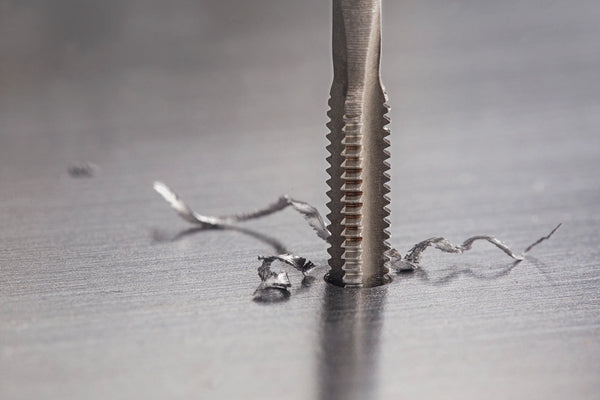
TapsMetric and inch taps: materials, pitch and selection.
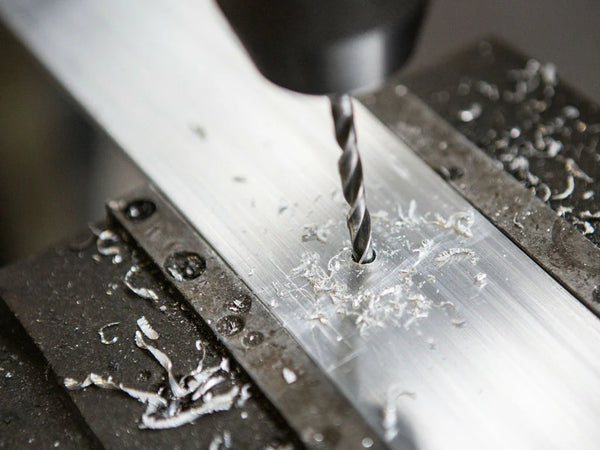
DrillsHSS, cobalt and carbide drills for every material.
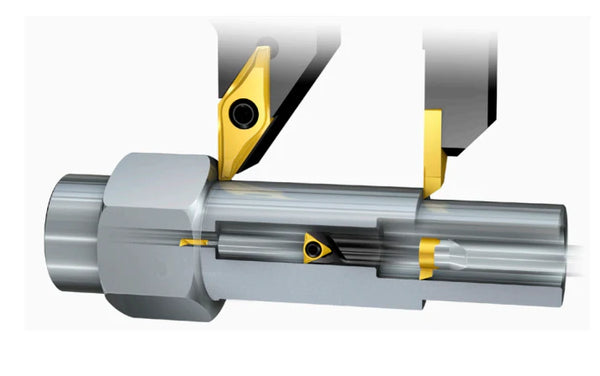
Lathe Cutting ToolsLathe inserts and tool holders: geometries and selection.
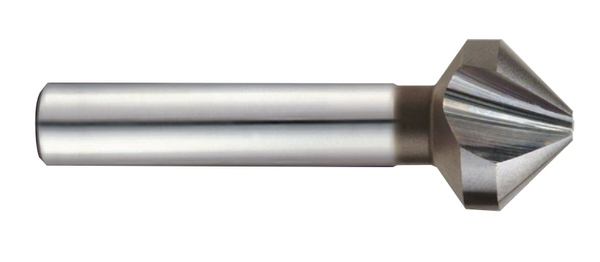
CountersinksChamfer and taper milling cutters.
Basic Cutting TheoryFundamentals of cutting: speeds, feeds and materials.
Machinable Materials (VDI 3323)Classification of workpiece materials per VDI 3323 (P-M-K-N-S-H groups).
[M] - STAINLESS STEELS (STAINLESS STEEL)Group M: stainless steels: machining peculiarities.
[K] - CAST IRONGroup K: cast irons: behavior and cutting parameters.
[N] - NON-FERROUS MATERIALS (NON FERROUS)Group N: non-ferrous (aluminium, copper) and their cutting.
[S] - SUPER ALLOYSGroup S: superalloys and titanium: difficult machining.
[H] - HARDENED MATERIALSGroup H: hardened materials: high-hardness cutting.
Cutting Tool MaterialsCutting-tool materials: HSS, carbide and coatings.
Carbide Rotary Burrs