
How to identify the thread on an old bolt
On most common fasteners, two measurements settle the question: the outside diameter and the pitch of the thread.
The goal is a complete thread designation, meaning a combination of diameter, pitch and standard. Neither measurement is enough on its own.
Metric thread
M8 × 1.25
Nominal diameter in mm and pitch in mm.
Inch thread
¼″ 20 UNC
Nominal diameter in inches, threads per inch and standard.
What you need
01
A caliper, for the outside diameter.
02
A thread pitch gauge, for the pitch.
03
The thread standards tables, so you can compare your readings against Metric, UNC, UNF, BSW, BSF, BSP, NPT and other systems.
Step 1: Clean and inspect the bolt
Remove oil, dirt, rust and debris from the grooves. The pitch gauge has to sit cleanly on the thread profile, so even small deposits can send you to the wrong answer.
Look the bolt over for:
Flattened or deformed crests.
Bruised or stripped threads.
Heavy corrosion.
A diameter that differs between the start and the end of the thread.
If the thread is badly worn, measure on the length that is in the best condition.
Step 2: Measure the outside diameter
Use the outside jaws of the caliper and measure across the crests of the thread. Do not measure the head of the bolt and do not let the jaws drop into the grooves. The measurement runs from crest to crest.

Close the jaws gently. Too much pressure gives a smaller reading, especially on small or worn fasteners. Repeat at two or three positions, rotating the bolt slightly. If the readings agree, keep the middle one.
Reading the result
The caliper reading normally sits close to the nominal diameter without matching it. The outside diameter of a thread is made to a tolerance on the low side, so that it assembles with the nut.
| Designation | Nominal Ø | Typical caliper reading |
|---|---|---|
| M6 | 6.00 mm | about 5.9 mm |
| M8 | 8.00 mm | about 7.9 mm |
| ¼″ | 6.35 mm | about 6.3 mm |
Diameter on its own is not enough. The next step is to establish the pitch.
Step 3: Measure the pitch with a thread pitch gauge
Fan out the leaves of the gauge and try them one after another on the thread. The correct leaf sits on the whole profile. Its crests and grooves have to coincide with those of the bolt, with no visible gaps.

Hold the pair up against a bright surface. If light shows between the leaf and the bolt, try a different pitch. Do not settle on a leaf because it matches one or two turns. The fit has to be right over as much length as possible.
Metric threads and pitch in millimetres
On metric threads the pitch is the distance from the crest of one turn to the matching crest of the next, expressed in millimetres. If the outside diameter is around 8 mm and the gauge reads 1.25 mm, the likely designation is M8 × 1.25. The M8 gives the nominal diameter, the 1.25 the pitch.
The same diameter is offered with more than one pitch. An M8 × 1.25 bolt is therefore not the same thing as an M8 × 1.
Inch threads and TPI
On inch threads the pitch is normally quoted as TPI, threads per inch. A bolt roughly ¼″ in diameter with 20 TPI may be ¼″ 20 UNC. The same diameter with 28 TPI may be ¼″ 28 UNF. A higher TPI means more turns in the same length, so the thread is finer.
Watch out
The inch designation stamped on the leaf
On some pitch gauges a thread designation in inches is stamped next to the TPI figure. In the photograph, the 10 TPI leaf carries ¾″ and the 9 TPI leaf carries ⅞″. Those are the standard Whitworth threads that run exactly that pitch, namely ¾″ BSW at 10 TPI and ⅞″ BSW at 9 TPI.
Such markings do not state the diameter of the bolt in your hand. When identifying a thread, take only the TPI figure from the leaf. Measure the outside diameter separately with the caliper, then combine the two values in the thread tables.

Do not confuse them with BSP pipe threads, which also carry the letter G but run different pitches: G ¾″ to BSP is 14 TPI, not 10.
Step 4: Combine diameter and pitch
You now hold the two figures that matter, the outside diameter and either the pitch in millimetres or the TPI. Open the thread standards tables and look for the combination closest to your readings.
The tables cover Metric coarse, Metric fine, UNC, UNF, UNEF, BSW, BSF, BSP, BSPT, NPT and other systems. You can filter on Major Ø, Pitch or TPI until the most likely designation comes up.

Example, metric bolt
Caliper: 7.9 mm
Pitch gauge: 1.25 mm
Likely thread: M8 × 1.25
Example, inch bolt
Caliper: 6.35 mm
Pitch gauge: 20 TPI
Likely thread: ¼″ 20 UNC
Step 5: Confirm the result
If you have a nut of known thread, use it as a final check. The bolt should turn smoothly by hand.
No force
Do not reach for a wrench and do not force it. A wrong thread can start to engage for a short distance and then wreck both parts.
The nut test confirms a result, it does not replace the measurement. Where the check has to be documented, GO and NO GO thread gauges take the place of the nut.
If nothing matches
If no clean match turns up, go back over the following:
01
Is the thread clean?
02
Did you measure across the crests rather than in the grooves?
03
Does the leaf of the gauge seat on the full profile?
04
Are you comparing a metric pitch against a TPI figure?
05
Could this be Metric fine, UNF or a less common standard?
06
Is the thread worn or deformed?
07
Does the diameter change along the length of the thread?
If the diameter varies, you may be looking at a tapered thread. That is common on some pipe threads such as BSPT and NPT.
On pipe threads the nominal size does not match the outside diameter shown by the caliper, because it refers to the nominal size of the pipe. That is why the reading has to be compared against the corresponding table.
The most common mistakes
Identifying by diameter alone. Two threads can share a similar outside diameter and still differ in pitch or in standard.
A careless fit with the pitch gauge. The correct leaf has to match the whole visible length of the thread.
Mixing up metric pitch and TPI. Metric pitch is the distance between two consecutive crests, while TPI counts how many turns fall within one inch.
Forcing the nut test. If the bolt does not turn easily by hand, stop and check the diameter, the pitch and the standard again.
← All guides
Related guides
GaugesΠώς οι ελεγκτήρες GO και NO GO μεταφέρουν τα όρια της ανοχής στο σημείο ελέγχου, χωρίς ανάγνωση αριθμού.
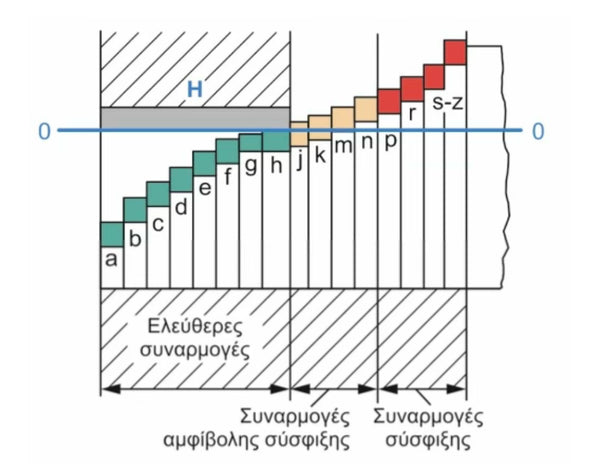
FitsΠώς η σχέση των ανοχών άξονα και τρήματος δίνει χάρη ή σύσφιξη, με το σύστημα ISO 286 και τον έλεγχο go/no-go.
Thread GaugesGO/NO-GO gauges for checking internal and external threads.
StraightedgesChecking straightness and flatness of surfaces per DIN 874.
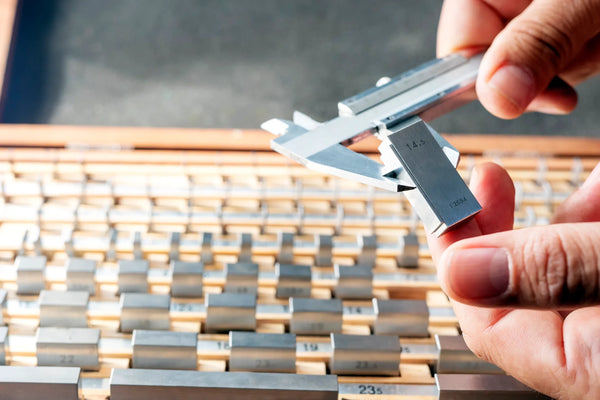
Gauge BlocksStandard length gauge blocks for calibration and setting.
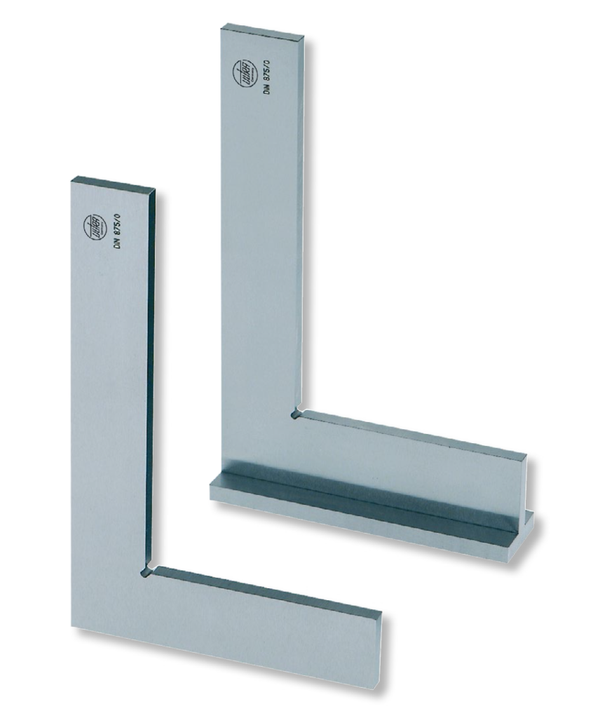
Precision Squares DIN 875Checking 90° squareness with precision squares.
Κατηγορίες Ακρίβειας Γωνιών: DIN 875Accuracy grades of 90° squares per the DIN 875 standard.
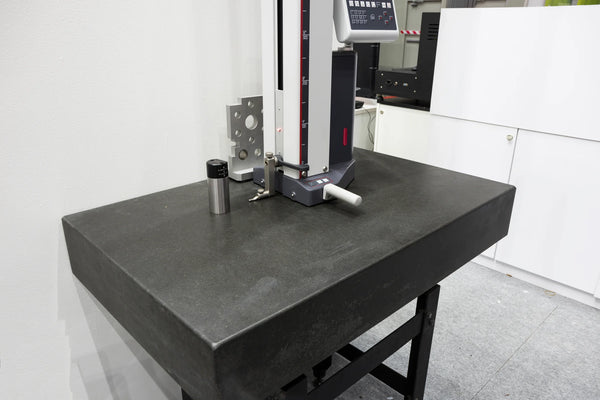
Surface PlatesGranite or cast-iron reference plates for flatness checking.